
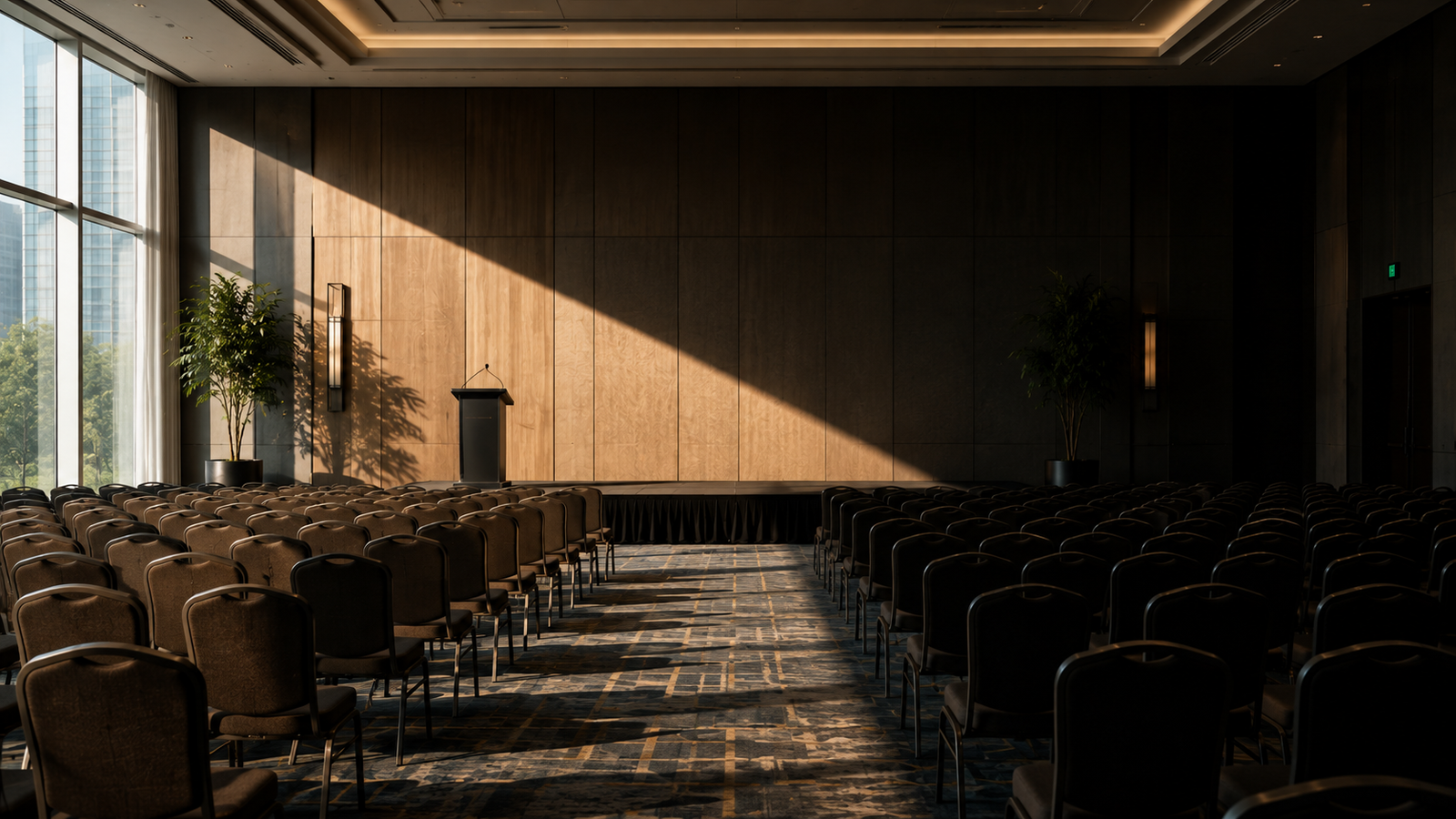
The Shadow in the Room
As astrologers gather in Chicago for UAC 2026, one of the most consequential conversations surrounds a speaker who will not be there. What began with Steven Forrest’s use of a racial slur has become something larger: a reckoning over race, accountability, professional power—and a community increasingly divided over what justice should look like.

The Shadow in the Room
UAC 2026 & the Steven Forrest Controversy
Before astrologers gather in Chicago, a public debate over race, accountability and professional power has already arrived.
As the United Astrology Conference prepares to open in Chicago on September 3, one of the most consequential conversations surrounding UAC 2026 concerns an astrologer who will not be speaking there.
Steven Forrest, one of the best-known figures in contemporary Western astrology and a leading teacher of evolutionary astrology, is no longer on the UAC speaker platform following a public controversy over comments he made during a July podcast conversation about race and “shadow work.”
This is no longer gossip. It is a public accountability issue inside a professional field. It has unfolded through institutional statements, public essays, social media posts, astrology forums and public-facing commentary. So far, the story appears to remain largely within the astrology community rather than becoming a major general-news story. That does not make it private. And, it has begun to attract some coverage beyond the field.
What began with the use of an anti-Black racial slur has become something considerably larger: a debate over racism, intention and impact, accountability, professional authority and what happens when a community accustomed to interpreting symbols is suddenly forced to interpret itself.
A Podcast, a Word, and a Larger Record
The controversy began with a July 23 episode of the Lila Astrology podcast featuring Forrest and former NFL player and astrologer Ricky Williams. During a discussion of racism in American history, Forrest, who is white, spoke the N-word aloud rather than referring to it euphemistically.
Critics also objected to other portions of the conversation, including discussion of the Ku Klux Klan, Forrest’s account of his own evolving understanding of race, and the way Williams’s presence in the conversation was later invoked by some as evidence that the exchange should not be regarded as harmful.
The original podcast later disappeared from public view. An edited version was subsequently made available with some of the disputed material absent, a change noted in Astrology University’s public statement. That editing further complicated a controversy already unfolding rapidly across Facebook, Instagram, Threads, podcasts, Substack essays and astrology forums.
Forrest has consistently denied being racist.
In an early public response, he apologized for what he called a lack of judgment while asking readers to consider the context in which the word had been spoken. That response included a sentence that quickly became another focus of the dispute: “Cancel me if you want, but don’t call me racist.”
He later offered a more direct apology and has continued to address the controversy publicly. In his August 23 essay, The Mess I Am In, Forrest wrote that he wished he had not used the word, acknowledged that its impact was real, and argued that the larger context of an anti-racist conversation had been lost. He also said that he had been banned from attending UAC and that his hotel reservation had been cancelled. UAC’s public statement itself addresses his removal from the speaker platform but does not detail those additional claims.
For many critics, however, the controversy had already ceased to be simply about the utterance of a slur.
It had become a question of accountability.
Astrological Institutions Respond
Astrology’s professional institutions soon became involved.
The International Society for Astrological Research, one of the organizations connected to UAC, said Forrest’s conduct had caused harm and recommended that he not be permitted to fulfill his contract as a UAC speaker, according to public accounts of its member communication. It also called for a broader discussion within professional astrology about racism, privilege and accountability.
An open letter circulated among astrologers went further, calling for Forrest’s removal from UAC and demanding measures including anti-racist education and financial support intended to increase Black participation within the astrological community.
UAC subsequently announced that Forrest had been withdrawn from the 2026 speaker platform. Publicly available versions of the statement say the board reviewed the podcast, Forrest’s subsequent public statements, correspondence with Forrest and letters from the community. The statement also noted that Forrest had emailed a voluntary withdrawal before the board’s public announcement was formalized.
The institutional fallout also extended beyond UAC. The National Council for Geocosmic Research removed Forrest as an NCGR Advisor and Participating Affiliate, a more direct organizational action than a conference-program change. That decision underscored that the controversy had moved from public criticism into formal institutional consequence.
NCGR’s response went further than a general statement of concern. The National Council for Geocosmic Research removed Forrest as an NCGR Advisor and Participating Affiliate, while also framing the controversy as more than a single spoken slur. In its statement, NCGR pointed to the racial slur, the repetition of a historically weaponized racist narrative, the framing of that material as “medicine” for shadow work, and the decision to publish the exchange. The organization also rejected the idea that the historical subject of the conversation, or the identity of the person Forrest was speaking with, removed responsibility for saying it.
Astrology University also severed its professional relationship with Forrest, removing him from its faculty and discontinuing the sale of his educational material through the school. Astrology University said that the decision concerned not only Forrest’s original remarks but what the organization regarded as an insufficient public response to the harm caused.
Other astrologers and organizations with longstanding professional or educational connections to Forrest have publicly distanced themselves from him, reconsidered whether to recommend his work, or called for further accountability within the field.
Yet the institutional response has not produced consensus.
It has produced another argument.
The Astrology Community Divides
Forrest retains substantial support within the astrological community.
Some supporters accept that his choice of language was wrong while rejecting the conclusion that it demonstrates racism. Others have criticized the institutional response as disproportionate and warned that demands for accountability can become punitive, coercive or careless with context.
Veteran financial astrologer Ray Merriman, for example, publicly defended Forrest in an August 10 column, arguing that Forrest’s remarks occurred in an anti-racist context and criticizing the reaction within the astrological community.
That distinction, between what Forrest intended and what his words did, has become one of the central fault lines of the dispute.
Forrest and many of his defenders emphasize context, character and a career they say provides ample evidence of his opposition to racism.
His critics reply that good intentions do not erase harmful conduct and that concentrating on whether Forrest is personally “a racist” avoids the more important questions of impact, responsibility and repair.
Both conversations are now occurring simultaneously, and increasingly they appear unable to hear one another.
There are also signs that the controversy is moving beyond disagreement over Forrest himself and into questions of professional association: who supports him, who condemns him, who signs statements, who remains silent and what consequences any of those choices should carry.
That development deserves scrutiny from all sides.
Accountability is a legitimate ethical concern. The harder question now is how the field distinguishes responsibility, repair and proportionate consequence from guilt by association or permanent exile.
A community can oppose racism without requiring unanimity about punishment. It can also ask for proportionality without minimizing harm.
The challenge is whether astrology’s institutions, teachers and students can hold both truths long enough to do something more useful than form rival camps.
UAC and the Shadow in the Room
That brings the controversy to Chicago.
UAC opens September 3. Forrest will not be on its speaker platform, but the argument surrounding him will inevitably arrive without him.
The conference itself is not avoiding the broader subject. UAC program materials reviewed by Magus Bear list an “Anti-Racism Capacity Building for Astrologers” workshop led by Samuel Reynolds, Imani Harmon and Katia Perez Fuentes on September 3. That matters. The conference is not merely hosting the aftermath of a controversy. It is also formally staging anti-racism work while the community debates whether its institutional response was adequate, excessive or incomplete.
ISAR has also indicated that its UAC gathering will begin a continuing conversation about accountability, privilege and what it describes as covert supremacies within professional astrology, as documented in public reporting and source compilation by Astrology by Ryan.
For a field that speaks frequently about shadow work, the symbolism is difficult to miss.
But astrology should resist the temptation to turn symbolism into an escape from journalism.
The important questions are painfully terrestrial.
What did Steven Forrest actually say?
What responsibility does a public teacher bear when his words cause harm regardless of his intention?
What constitutes meaningful repair?
What authority should professional organizations possess over speech and conduct?
When does accountability become ostracism?
And can colleagues disagree about those questions without transforming one another into enemies?
Those questions matter beyond Steven Forrest.
They concern the kind of professional community astrology intends to become.
Forrest’s critics are asking the field to confront racial assumptions and structures that they believe have gone insufficiently examined. His defenders are increasingly asking whether the mechanisms being used to accomplish that reckoning leave room for context, proportionality, forgiveness and dissent.
Neither question disappears simply because the other is uncomfortable.
The danger now is that astrologers retreat into two camps, each convinced that only the other side has a shadow.
If that happens, the controversy that began with Steven Forrest will cease to be about Steven Forrest at all.
It will leave the astrology community facing the question it can no longer project onto him:
What kind of community are we becoming?
Further Developments:
The Conversation Reaches Chicago
Updated September 4, 2026
Since this article was published, the controversy surrounding Steven Forrest has continued to widen beyond the question of Forrest himself.
On September 3, as UAC opened in Chicago, the conference hosted “Anti-Racism Capacity Building for Astrologers,” led by Samuel Reynolds, Imani Harmon and Katia Perez Fuentes. The workshop is now confirmed in UAC’s official conference schedule, where it appeared immediately before the opening ceremony.
UAC also publicly promoted the session, describing it as an opportunity to move the community toward anti-racist capacity building. A separate page created for the workshop describes it as a participatory session in “restorative anti-racism practices,” open to astrologers at every level of readiness. The organizers note that the session would not be recorded or distributed by UAC and have established an email list for resources and developments following the workshop.
UAC 2026 conference schedule
Anti-Racism Capacity Building for Astrologers — workshop page
The circumstances surrounding the workshop have themselves become part of the conversation. UAC acknowledged publicly that assembling the session at short notice had been challenging, writing, “You asked, we listened,” while thanking Reynolds, Harmon and Perez Fuentes for leading it. That matters because the institutional response to Forrest has increasingly shifted from the question of whether one astrologer should appear at a conference toward a harder question: what does repair actually require from the institutions involved?
UAC announcement of the anti-racism workshop
The controversy has also reached one of astrology’s most influential media platforms. The Astrology Podcast devoted an extended discussion in its September forecast episode to the Forrest controversy and directed listeners toward responses from Black astrologers and other community voices, including Samuel Reynolds, Akwe McDaniels, Kay Marie, Janét Jones, Nichole Zapanta, Courtney Napier and Rachel Star. This represents a significant expansion of the public record: the conversation is increasingly being documented not simply as a dispute over Forrest’s language, but as a debate over race, institutional power, accountability and the culture of professional astrology.
The Astrology Podcast — September Astrology Forecast 2026
Other astrology podcasts are engaging the controversy as well. The Awake Space with Laurie Rivers has addressed both the Forrest dispute and broader arguments about exclusion within Western astrology, another indication that the issue is moving beyond individual social-media exchanges into sustained discussion within astrology media.
What is emerging in Chicago therefore complicates the original story.
Forrest’s absence from UAC is now only one part of it.
The more consequential question may be whether the controversy becomes an occasion for sustained institutional examination—or whether the astrology community simply divides into competing accounts of who has been harmed, who possesses authority, and what accountability ought to mean.
There is an important distinction here. The Forrest controversy did not necessarily bring astrology’s racial shadow into the room. For many of his critics, it exposed a shadow that was already there.
Whether UAC 2026 becomes remembered primarily for the astrologer who was absent, or for the conversation his absence forced into the open, remains to be seen.
Reporting note: This article is based on public statements and public-facing material from Forrest, UAC, ISAR-related communications, Astrology University, public essays by astrologers and astrology publications, and major public social/forum discussions. Magus Bear has deliberately not reported private conversations or unattributed claims.
Sources and Further Reading
- UAC 2026 Board statement withdrawing Steven Forrest from the speaker platform
- Steven Forrest, “The Mess I Am In”
- Astrology University statement regarding Steven Forrest
- Astrology by Ryan, “Steven Forrest: Shadow Work – A Record”
- Open Letter to Steven Forrest and the Greater Astrological Community
- Ray Merriman, MMA Free Weekly Column for the Week Beginning August 10, 2026
- Reddit discussion, r/astrology
- Reddit discussion, r/Advancedastrology
- UAC 2026 — Official Conference ScheduleAnti-Racism Capacity Building for Astrologers — Workshop Resources
- UAC announcement of the Capacity Building workshop
- The Astrology Podcast — September Astrology Forecast 2026
Continue exploring…
For more articles about astrology, faith, meaning, memoir, and the life we share beneath the sky, explore Reflections.