
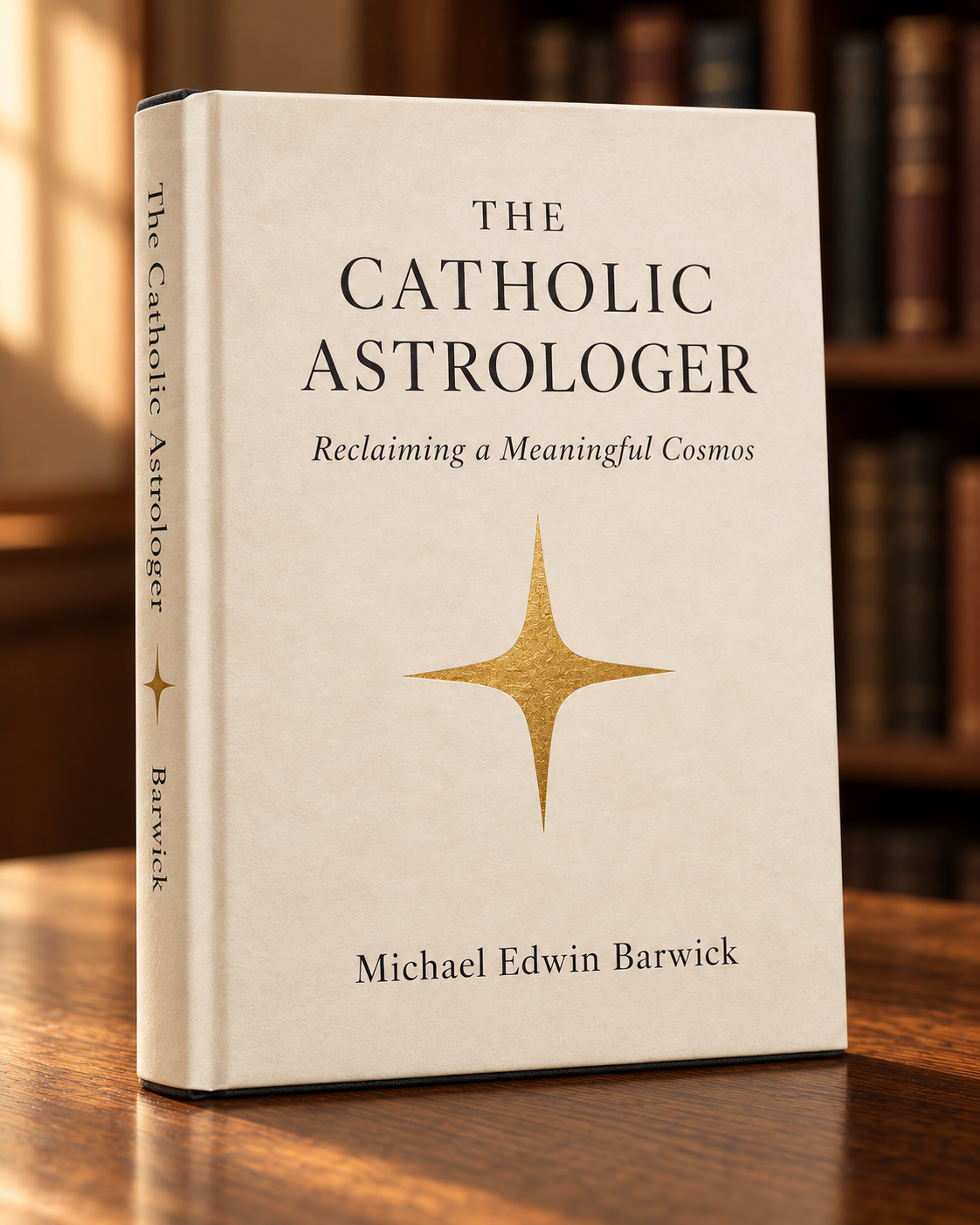
The Catholic Astrologer
Can we reject superstition without losing a meaningful cosmos? Discover The Catholic Astrologer: Reclaiming a Meaningful Cosmos by Michael Edwin Barwick—a contemplative exploration of faith, freedom, and the heavens. Read an excerpt and download a preview of the forthcoming book.
A forthcoming book
The Catholic Astrologer
Reclaiming a Meaningful Cosmos
By Michael Edwin Barwick
What does it mean to inhabit a creation that speaks?
A contemplative inquiry into the heavens, human freedom, and the possibility of receiving the cosmos as meaningful.
About the book
Learning to look up again
For Michael Edwin Barwick, a lifelong fascination with the sky became a philosophical and theological question: how can the world hold patterns and correspondences—meaningful relationships between what appears in the heavens and what unfolds in human life—while human beings remain free?
The Catholic Astrologer follows that question through the Christian imagination, the Church Fathers, the medieval cosmos, and the modern experience of disenchantment. It explores whether the heavens can be contemplated as signs within creation while preserving trust in providence and responsibility for our choices.
The book invites readers to consider how attention to the created world might deepen wonder, gratitude, and praise.
Part I
The Question Returns
Our longing for pattern and meaning opens questions about causation, freedom, and the experience of time.
Part II
When the Symbolic World Thinned
A consideration of disenchantment and the possibility of learning to perceive symbolic depth again.
Part III
A Tradition Revisited
The Magi, the medieval cosmos, and the relationship between symbolic interpretation, freedom, and providence.
Part IV
The Return
A gathering of the argument into a contemplative vision of creation and an invitation to praise.
An excerpt from the Preface
Where the questions began
From the current manuscript of The Catholic Astrologer.
I was not born into the Catholic faith. I grew up in a home filled with books — psychology, philosophy, religion, and eventually astrology. Of these subjects, astrology eventually held my attention most persistently.
However, my fascination with the heavens began long before I knew the difference between astronomy and astrology.
In kindergarten, our class built the planets from papier-mâché and hung them from the ceiling on fishing line. I was captivated. At home, I filled an entire sketchbook with drawings of each planet and persuaded my father to mount them along the living-room wall. Long before I asked whether the heavens were meaningful, I knew they were beautiful. The planets felt less like distant objects and more like companions inhabiting the same universe as I did.
Around the same time, I had my first clear memory of a conversation about God. One evening, after my father awoke from an after-dinner nap, he realized he needed cigarettes and prepared to set out on what he jokingly called a “tobacco run” to the convenience store several blocks away. That time, I persuaded him to let me come along. To a small child, the journey felt like an expedition: across the grass of the housing complex, over a brook, beneath towering hydroelectric lines, across the schoolyard, and finally to the brightly lit store. We talked the entire way. My father often spoke about God, faith, and the importance of belief, usually in simple, practical terms.
On the walk home, I asked him how we could know that God was real. He opened his newly purchased pack of cigarettes, removed a small piece of foil, and released it into the evening breeze. I watched it glimmer in the fading light as the wind carried it across a nearby field. “God is like the wind,” he said. “We can’t see the wind, but we can see what it does. We can’t see God, but we can see what He does.” The explanation was hardly a formal argument, but it lodged deeply in my imagination. Ever afterwards, I found myself looking for signs of God’s presence and activity in the world. In retrospect, a conversation began that evening which has never entirely ended.
Sometime later, after my family moved from the city to a small town, I began constructing crude horoscopes for friends and family with my mother’s small collection of astrology books. What fascinated me was not prediction but pattern: the strange interplay between what individuals seemed to share and what made each person distinct.
Astronomy was part of the picture too. As a teenager, after purchasing my first book of star charts, I spent a late summer night watching Orion rise above the horizon before fading into dawn. One Christmas, I received a telescope, which led to many evenings spent observing all the heavenly bodies—from the moon to the Andromeda galaxy. I grew up interested in and pursuing knowledge and experience in both astrology and astronomy.
Over time, these interests led to deeper questions astrology itself could not answer. What kind of universe permits correspondences—meaningful relationships in which patterns in the heavens appear to reflect, signify, or illuminate patterns in human life—without collapsing into fate? What becomes of freedom if such patterns are real? How can order exist without overriding human responsibility?
These questions gradually moved beyond astrology and science towards philosophy and theology.
Before you begin
Questions readers may bring
Is this a book about predicting the future?
The book’s purpose is contemplative. It explores symbolic reflection on cosmic order, with an explicit rejection of fatalism and divinatory control.
How does the book approach Catholic faith?
Its inquiry takes place within the author’s Catholic faith and draws on Christian discussions of creation, providence, and freedom. It presents his argument for readers to consider.
Do I need a background in astrology or theology?
The argument begins with familiar questions about meaning and human experience, then develops its philosophical and theological foundations. The manuscript includes a lexicon and appendices addressing common questions and historical sources.