
Weeping Willow: My First Spell Was a Prayer
A wounded willow sapling became my first lesson in guilt, ritual, and the mysterious power of sacred attention. This childhood memoir recalls a very young boy, a damaged tree, and the first strange intuition that words, gesture, remorse, and love might somehow participate in the healing of what has been harmed.

WEEPING WILLOW
My First Spell Was a Prayer
It was a willow sapling that first introduced me to magic.
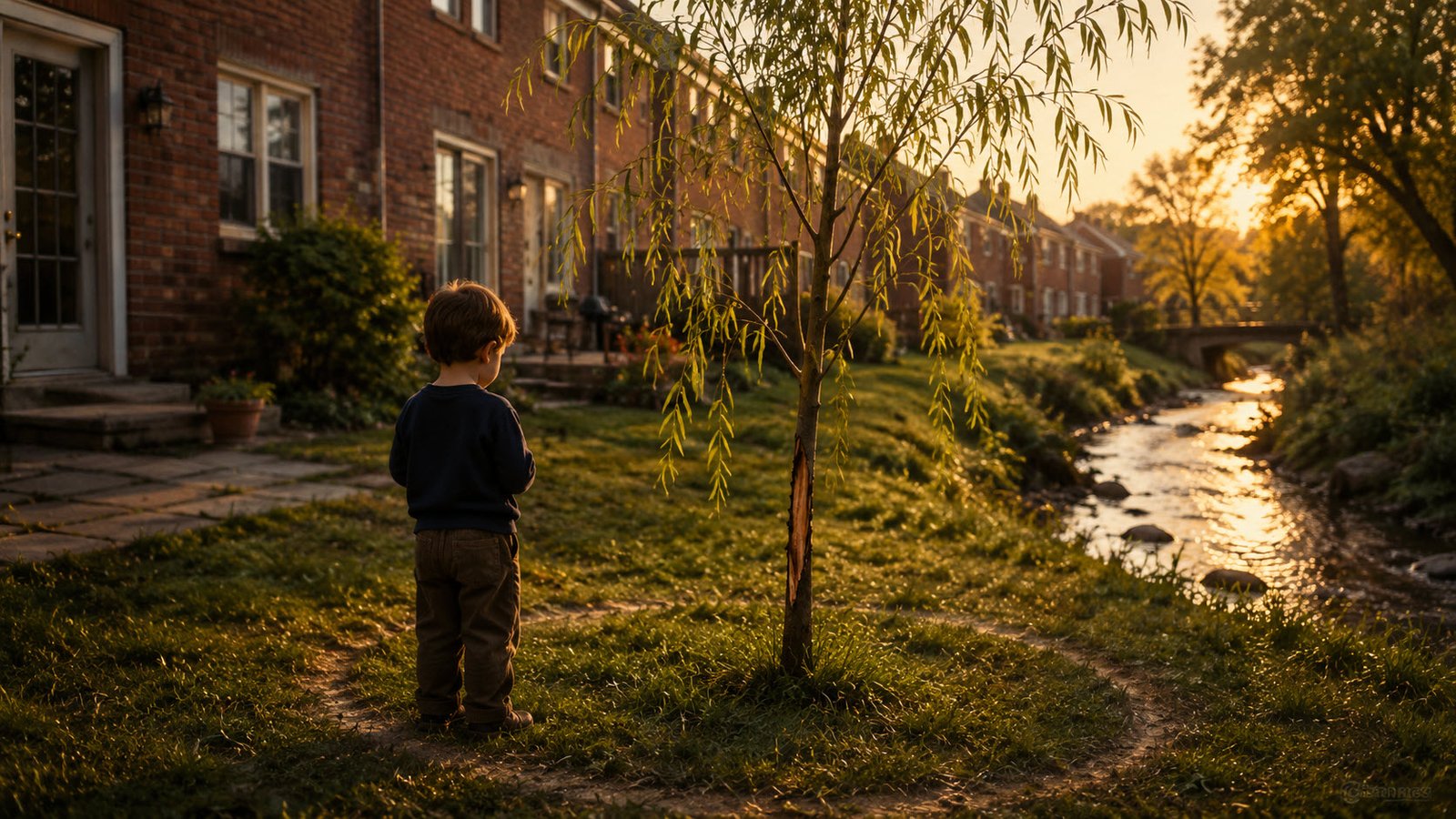
Or perhaps I should say more carefully: it was the willow that first taught me the power of ritual. I was somewhere older than three and a half, but perhaps not much beyond four yet. The sapling may have been only six feet tall, but from where I stood, it towered over me. It was young, green, bending, alive — and it belonged, in the way children believe things belong, to us.
At the time, my family lived in an unremarkable block of red brick townhouses in the city. The units were arranged around a concrete common area that led to the front doors. There were several such courts, all following the bend of a suburban street. Nothing about the place would have seemed especially magical to an adult. But the back doors opened onto another country altogether.
Behind the townhouses ran a strip of green space, with recently laid sod, saplings, bushes, and a creek flowing parallel to the houses. To my childhood imagination, this was not landscaping. It was wilderness. It was possibility. It was the world behind the world.
I had already had a dream out there once, or so I remembered it: a faerie, a bear, and a bear-sized vulture appearing in the backyard territory beyond our door. So when the willow sapling seemed simply to arrive one day near the creek, a little south of our patio stones, I accepted it as part of the order of things. The world was full of sudden arrivals. Wonders did not need explanations.
Other willows had been planted along the green space, but this one was closest to our back door, and so we considered it ours. My father noticed it too. He was an art teacher and had an eye for natural beauty, especially trees. On school days, he came home by walking along the green space from the road to the south, and after the willow was planted, he would often look at it as he passed.
One day, a group of boys were playing near the creek. I no longer remember what we were doing. I only remember that at some point one of the boys took out a penknife and cut a strip of bark from the willow.
Others joined in.
I joined in.
Between my fingers, I felt the dry outer bark peel away, and beneath it the softer, darker, moist underside. I remember the texture. I remember the crumbling little strips. I do not remember any malice. I do not think any of us imagined we were doing anything very serious. To a child, bark seemed like skin, and skin healed. What was a strip here or there?
Later that day, my father came home from work and noticed the damage.
He entered the house upset and announced what had happened. In his sternest voice, he said that someone had vandalized the willow, and that this was not only a very bad thing to do, but that it might kill the sapling.
“A tree cannot live without its bark,” he said.
I was horrified.
I protested. Wouldn’t the bark grow back? Surely it would grow back. Skin grew back. Scabs formed. Cuts healed. Why not bark?
My father sadly told me no. He did not know that I had been one of the boys who stripped it. He did not seem to suspect me at all. Perhaps it was unthinkable to him that a son of his would take part in such an act. And I certainly was not going to tell him.
So I said nothing more.
But now I had a secret, and the secret weighed on me. I had done something wrong before I understood it was wrong. Worse than that, I had wounded a living thing. A tree might die because of me.
Something had to be done.
Not confessed, apparently. Not yet. I was too little, too frightened, too ashamed. But something.
Soon after, when I found an opportunity to be alone with the willow, I began to perform a ritual.
At the time, I would have called it magic. Looking back, I suspect the outer form of it may have come from television. Bewitched had entered the world the same year I did, and by then its domestic enchantments must have been somewhere in the imaginative air I breathed. Magic, as that world presented it, did not belong only to ancient forests and fairy-tale castles. It happened in ordinary houses, in kitchens and living rooms, in suburban neighbourhoods, in the middle of daily life.
Perhaps television gave me the grammar: words, gestures, intention, the sense that an unseen power might be addressed.
But television did not give me the grief.
Television did not give me the guilt.
Television did not give me the desire to heal the willow.
I circled the sapling, semi-singing nonsense words that I made up as I went. I had no idea what I was doing, and yet I knew exactly what I was doing. I walked round and round the young tree with the whole force of my small will fixed upon it. In my mind was the wounded willow and a child’s fervent desire for healing.
Now and then, as I circled, I caught my reflection in the glass of the back doors and windows of the townhouses. There I was, solemn and strange, moving around a tree in the green space behind a row of ordinary suburban homes. I must have looked ridiculous. I must also have been entirely sincere.
I did not yet know the word “ritual.” I did not know the word “prayer” in any serious sense. I knew nothing of sacrament, blessing, penance, intercession, or the religious instinct to answer a wound with an act. But some primitive form of all those things was already present.
Something living had been harmed.
I was partly responsible.
Standing still with my guilt was not enough.
So I moved. I sang. I circled. I pleaded. I blessed.
Long before I understood religion as belief, I understood it as something done with the whole body. Words mattered. Gesture mattered. Intention mattered. The invisible might respond. The world, if approached with enough seriousness and need, might hear.
What happened next can be explained in several sensible ways. Perhaps the damage was not as extensive as my father had feared. Perhaps willow trees, especially when planted near water, are more resilient than he knew. Perhaps the sapling was never truly in danger.
Whatever the reason, the willow lived.
For all I know, it lives still.
But at the time, each new leaf was evidence. Each sign of growth filled me with quiet satisfaction. The willow had survived. My ritual had worked. The world had answered.
That was my first experience of magic.
And perhaps, more truly, my first experience of religion: not as doctrine, not as argument, not as something imposed from outside, but as the conviction that love, remorse, gesture, and sacred attention might somehow participate in the healing of what has been wounded.
My first spell was a prayer before I knew what prayer was.
I believed.
Continue exploring…
For more articles about astrology, faith, meaning, memoir, and the life we share beneath the sky, explore Reflections.