
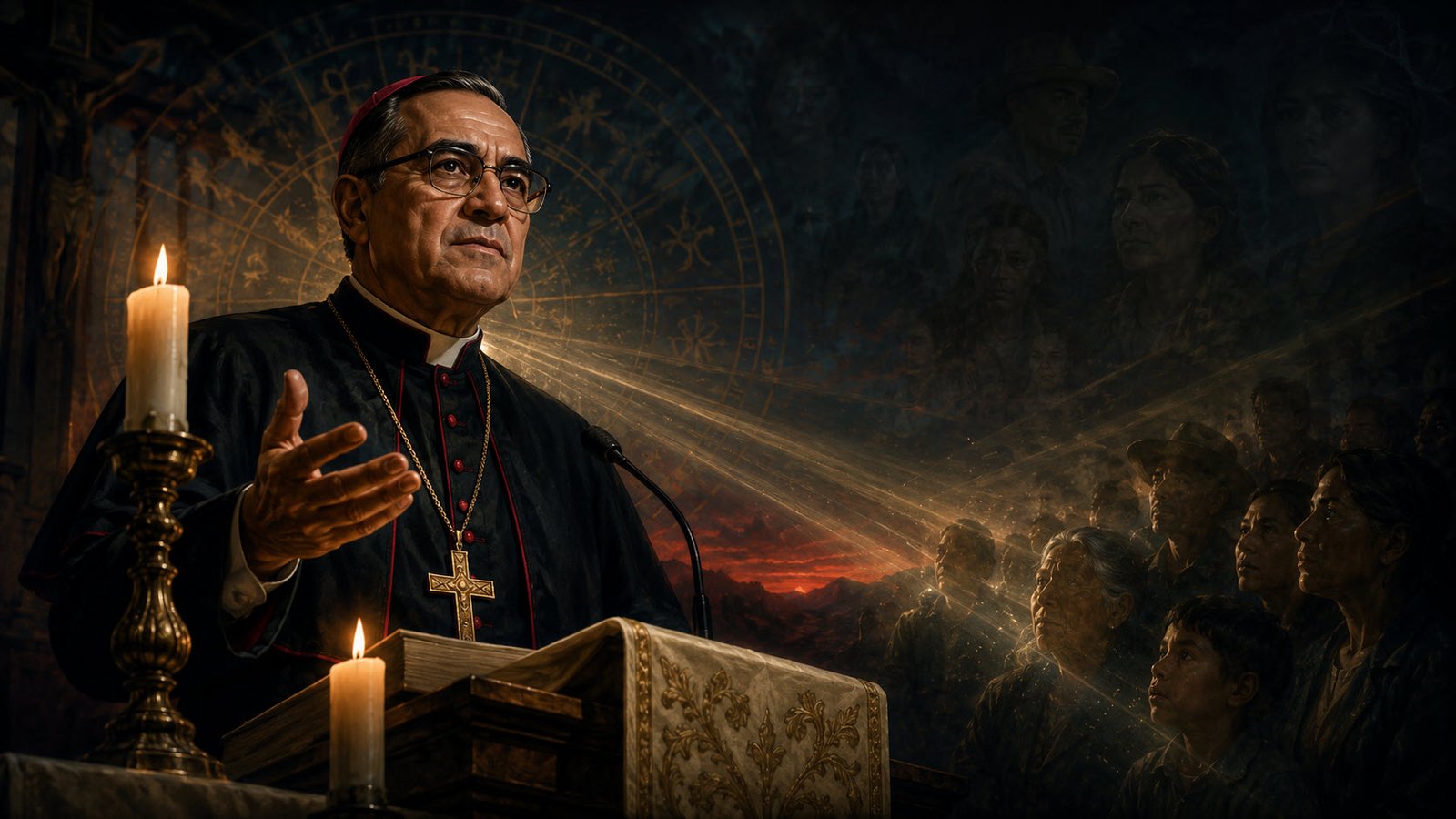
Óscar Romero: The Dangerous Word
Óscar Romero did not become a dangerous man by seeking danger. He became dangerous because he allowed hidden suffering to speak through him. This reflection reads Romero’s nativity as a symbolic portrait of receptive courage, public responsibility, disciplined service, and the costly word that emerges when conscience can no longer remain private.

ÓSCAR ROMERO
The Dangerous Word
Óscar Arnulfo Romero served as Archbishop of San Salvador for only three years, yet during that brief and increasingly violent period he became one of the most trusted public witnesses to the suffering of El Salvador. His homilies reported killings and disappearances, challenged official falsehoods, condemned violence from both right and left, and insisted that Christian faith could not remain indifferent to the violation of human dignity.
On 24 March 1980, Romero was assassinated while celebrating Mass in the chapel of the Hospital of Divine Providence. The Catholic Church later recognized him as a martyr, and Pope Francis canonized him on 14 October 2018. The United Nations observes 24 March as the International Day for the Right to the Truth concerning Gross Human Rights Violations and for the Dignity of Victims, choosing the date in honour of Romero’s witness. (Vatican Press)
His nativity invites us to contemplate a difficult human and vocational question:
How might a person receive hidden suffering so deeply that giving it a public voice becomes a matter of conscience?
The horoscope cannot explain Romero, confer sanctity, or account for the choices through which his character emerged. Its influence, in the sense used here, is indicative rather than directive—and certainly not physical. The chart offers a symbolic lens. We look through it to see whether it reveals something previously unseen about the life, while allowing the life itself to confirm, deepen, complicate, or refuse the interpretation.
The technical astrology has been gathered at the end of the essay. Readers may pass over it without losing the human argument. It is there to show how the reflection remains anchored in the craft without asking everyone to learn its technical vocabulary before encountering its meaning.
A Nativity We Can Use with Confidence
Romero’s birth time carries an AA Rodden rating, indicating a recorded time of the highest available reliability. The supplied data gives 15 August 1917, 3:00 a.m., in Ciudad Barrios, El Salvador. That allows the angles, houses, and proximity of planets to those angles to be considered with confidence.
A Life That Could Not Remain at a Distance
The first impression offered by Romero’s nativity is one of profound receptivity.
He appears to have met experience not primarily by standing outside it and forming an immediate judgment, but by allowing human circumstances to register personally. This need not mean sentimentality. It suggests a way of knowing in which belonging, memory, vulnerability, and the condition of other people become difficult to treat as abstractions.
Some people can witness suffering and retain a clear division between what is happening to others and what belongs to them. Romero’s life suggests that this boundary became increasingly permeable. The suffering of the people entrusted to him did not remain an unfortunate social fact somewhere beyond the walls of the Church. It entered the meaning of his office and, eventually, his understanding of himself.
Yet this receptivity did not appear without tension. His sensitivity existed alongside restraint, seriousness, institutional loyalty, and a strong sense of responsibility. He was not naturally a political firebrand. He had a reputation for caution and was initially welcomed by conservative interests who expected him to restrain clergy associated with more confrontational social ministries.
This matters because it prevents the story from becoming too easy.
Romero was not born into the final form of his courage. Nor did one event magically replace one personality with another. His development appears to have been gradual: a widening recognition of who belonged within the field of his pastoral responsibility.
The murder of his friend, the Jesuit priest Rutilio Grande, and Grande’s two companions in March 1977 became a decisive moment. The Archbishop Romero Trust describes the killings as having shaken the newly installed archbishop deeply. (The Archbishop Romero Trust)
The chart does not explain that response. It does, however, invite us to notice the enlargement of a powerful instinct to protect.
The Widening Circle of Care
The capacity to care does not automatically produce moral courage.
A person may protect family, Church, class, nation, or inherited order while remaining indifferent to those outside its accepted boundaries. Belonging can become either a shelter or a wall.
Romero’s life reflects a gradual widening of the circle.
Rural workers, catechists, persecuted priests, grieving families, and those whose suffering had been pushed beyond respectable attention increasingly became recognizable to him as members of the Church’s own body.
Grande’s assassination did not introduce compassion into a man who had possessed none. It seems to have brought accumulated experience into sharper moral focus. Violence against the poor could no longer be regarded merely as a regrettable political problem surrounding the Church. The injury had entered the relationship.
The following Sunday, Romero suspended the regular Masses of the archdiocese and called the people together for a single celebration. The gesture made visible what violence had attempted to fragment: one wounded ecclesial body gathered in public.
But the chart did not choose the single Mass.
Romero did.
When Hidden Suffering Becomes Vocation
Romero’s public office placed him within a world of ceremony, hierarchy, and institutional expectation. Yet his nativity suggests that vocation repeatedly drew him toward what respectable institutions and political authorities preferred to keep out of sight.
His call was not merely to occupy office, but to bring public responsibility into contact with hidden suffering.
That distinction is central. One may hold authority while remaining protected from the realities over which that authority presides. Romero increasingly allowed concealed violence, fear, disappearance, and institutional complicity to enter the field of his public work.
Action did not seem to arise from aggression for its own sake. It emerged through protection.
This form of courage may hesitate longer than the courage of someone who delights in confrontation. It can appear cautious until a threatened person or community has been taken into care. Once that relationship has been established, however, retreat becomes morally costly.
Romero’s action increasingly reflected this pattern. He did not become combative in the abstract. His public resistance grew as the vulnerable ceased to be an issue and became his people.
The nativity also suggests that this field of action was difficult but strangely usable. Hidden danger and institutional conflict were hardly congenial circumstances for the man. Yet they became circumstances within which his capacity to protect could operate with unusual consequence.
His public role gradually acquired the quality of an offering. Authority was not merely possessed; it was placed at the service of something that might demand personal cost.
Compassion Must Become Work
Feeling suffering is not the same as responding effectively to it.
Compassion can become overwhelming. It may fill the inner world with grief, outrage, or helpless identification without yet producing anything durable.
Romero’s nativity suggests a recurring movement from immersion in suffering toward disciplined service.
What enters the heart must also enter the calendar, the archive, the office, and the repeated labour of responsibility.
This movement is vividly reflected in Romero’s ministry. His archdiocese gathered testimony, investigated cases, maintained records, assisted people in danger, and incorporated current events into weekly preaching. His homilies did not remain at the level of general moral exhortation. They became one of the few places where scattered accounts of violence could be assembled into a more truthful public picture.
The transformation here is not from compassion to coldness.
It is from compassion as feeling to compassion made durable through form.
Grief becomes documentation.
Concern becomes consultation.
Moral outrage becomes work that can be performed again tomorrow.
Conscience and the Order of Value
Another central theme in Romero’s nativity concerns value: what may be relied upon, what deserves protection, and what no institution has the right to sacrifice.
The life repeatedly placed personal moral judgment in relation to systems with far greater material and coercive power.
In El Salvador, questions of value could not be separated from land, labour, wealth, privilege, and the worth assigned to human lives. Romero did not become an economist, nor can his chart prescribe a political programme. The deeper issue was one of moral order.
What remains non-negotiable when institutions, property, and political stability are being preserved through torture, disappearance, and murder?
Romero increasingly answered that question publicly.
He condemned violence from revolutionary groups as well as from the state. Yet he rejected the claim that order could be defended through the destruction of human dignity. The preservation of institutions could not justify the sacrifice of the people those institutions existed to serve.
This is where protection matures into conscience.
Responsiveness notices suffering.
Conscience asks what that suffering reveals about the order of value.
Vocation raises the harder question of what must now be done.
The Dangerous Word
The most distinctive feature of Romero’s public ministry was not simply that he spoke.
It was the way he gave language to what others were being encouraged to ignore.
He named events. He distinguished testimony from rumour. He placed private grief within a larger moral and ecclesial reality. He used the authority of the pulpit not only to proclaim principles but to make specific human suffering publicly audible.
His homilies and radio broadcasts became a source of information in a country where much of the press would not report state violence. They detailed killings, torture, and disappearances, preserving names and incidents that power preferred to erase. (National Catholic Reporter)
This is not merely a gift for speech. It is a discipline of attention.
To speak responsibly under such conditions requires more than passion. It requires the ability to observe carefully, verify patiently, distinguish accurately, and resist the temptation to turn every fact into a slogan.
Romero’s rhetoric became powerful because it was answerable.
The relational quality of his speech mattered as much as its precision. He could condemn an act without denying the humanity of the person who committed it. His appeals to soldiers were addressed to their consciences because he continued to regard them as moral beings capable of refusing an unjust command.
That is a far more demanding use of language than simply dividing the righteous from the irredeemable.
Under violent conditions, politeness can become complicity if it requires the truth to remain unspoken. Yet truth can also become another weapon when it is stripped of relationship and used merely to humiliate an enemy.
Romero’s most dangerous words attempted something harder: truth spoken in a way that still called the hearer back into moral responsibility.
The dangerous word was not inflammatory speech.
It was the accurate word.
It restored names to those being erased, connected private grief with public reality, and made cultivated ignorance harder to maintain.
Office Learns from Community
Romero remained an institutional man.
His development did not require him to abandon the Church, but to ask more deeply what episcopal office existed to serve.
Responsibility seems to have entered him as a burden before it became a source of freedom. His caution, loyalty to order, and concern for the unity of the Church were not discarded. They were gradually enlarged by listening.
The officeholder discovered that the institution could not be understood only from the centre. It also had to be understood through the experience of those at its margins.
Romero’s episcopal motto, Sentir con la Iglesia, is often translated as thinking or feeling with the Church. In his final years, “the Church” came increasingly to include catechists, rural workers, persecuted priests, displaced families, and grieving communities.
The people did not replace the institution.
They revealed more fully what the institution was for.
Romero did not become courageous by ceasing to be an archbishop. He became courageous by allowing the suffering Church around him to deepen his understanding of what being an archbishop required.
Responsibility remained.
The community enlarged the authority to which it answered.
The Life Answers
The single Mass after Rutilio Grande’s murder offers one historical expression of the chart’s central call. A wounded community was gathered rather than scattered. Hidden violence was interpreted publicly. Grief was given form.
But Romero’s answer was not confined to one dramatic act.
During the following three years, he repeatedly used his office to investigate reports, accompany victims, challenge violent power, and preserve names against disappearance. His homilies became acts of collective memory.
On 23 March 1980, he addressed members of the armed forces directly. He reminded them that the peasants they were killing were their own brothers and sisters and appealed to them to obey conscience rather than orders to sin. His final command was plain: stop the repression. (Church Life Journal)
The following evening, he was shot while celebrating Mass at the Hospital of Divine Providence.
Nothing in the horoscope signifies a bullet.
No house predicts assassination. No planet causes martyrdom. No fixed star confers sanctity or issues a celestial death sentence.
The chart contains symbols that may be contemplated in relation to force, danger, hidden power, threatened life, public consequence, and bodily vulnerability. Those symbols have ten thousand possible forms. They do not determine the historical form they will assume.
The same roots might have accompanied fearful withdrawal, factional loyalty, institutional self-protection, retaliatory aggression, or polished speech that never became dangerous because it never became fully answerable.
The symbolism acquired moral significance through Romero’s response: whom he chose to protect, what he chose to name, and which methods he refused to adopt.
Character as a Widening Response
Romero’s earlier caution belongs in the story.
Without it, development disappears and biography becomes hagiography.
His courage was not delivered fully formed at birth. It appears to have grown through exposure, grief, consultation, prayer, responsibility, and repeated decisions not to look away.
The capacity to protect widened beyond familiar loyalties.
The difficulty of confrontation found a form that did not imitate the violence it opposed.
Office became increasingly accountable to community.
Careful speech became solidarity.
A concern with value became a public judgment about what no political order could legitimately sacrifice.
These are interpretations, not mechanisms.
The horoscope does not tell us why Romero made these choices when another person might not have made them. Even if astrology could demonstrate that many people with similar placements responded in similar ways, it would not explain why everyone did not.
That question belongs to biography, circumstance, relationship, character, freedom, and grace.
What the Lens May Help Us See
Romero’s nativity did not cause his vocation, suffering, holiness, or death. Planetary strength does not make a person good, and difficulty in a planet’s condition does not make someone weak or corrupt.
The chart offers a symbolic field through which certain recurring themes become more visible: receptivity, belonging, protective action, hidden suffering, disciplined service, moral value, institutional burden, community, and the responsibility to make concealed realities speakable.
For a Christian, the deepest source of Romero’s response belongs to the mystery of freedom and grace. Astrology may help us contemplate the human terrain across which that response unfolded. It cannot explain away the person who crossed it, prove divine favour, or authenticate sanctity.
Its usefulness lies elsewhere.
It invites us to look again.
The Shape of the Call
Romero’s nativity offers the image of a deeply receptive person whose public responsibility drew him toward suffering that power preferred to conceal.
The pattern begins with belonging: an inclination to receive human circumstances personally. It develops through a widening circle of protection. It moves toward the difficult work of giving concealed suffering form, record, and voice. It places conscience in relationship with collective power and asks whether public office will protect itself or become answerable to those it was created to serve.
None of this required the life Romero lived.
The same symbolic roots might have accompanied guarded loyalty, private anguish, institutional retreat, or eloquent caution.
Romero’s life gave them another historical form.
Hidden violence became documented truth.
Protective instinct widened into public solidarity.
Office became accompaniment.
Speech became a place where those being erased could hear that they had not vanished.
The chart offers the shape of a call; the life reveals the answer.
In Óscar Romero’s case, that answer was not the absence of fear. It was the widening of protection into conscience—and the discovery of the dangerous word: the word that named what power required to remain hidden.
Continue exploring…
For more articles about astrology, faith, meaning, memoir, and the life we share beneath the sky, explore Reflections.
Under The Hood: The Astrological Architecture
The following technical notes show how the interpretation was constructed. They are not additional meanings that readers must learn. They are the layered testimonies from which the synthesis was inferred. The chart data and technical conditions below follow the supplied preliminary astrological analysis.

Birth Chart
The Nativity of Óscar Romero
- Date
- Time
- UTC−06:00
- Place
- Ciudad Barrios, El Salvador
About Rulers and Almutens
The ruler of a house is its ordinary governor by sign: the planet normally responsible for conducting that house’s affairs.
The Almuten is the planet with the strongest claim at the exact degree of the house cusp, based upon its essential dignities there.
No metaphor is perfect, but the ruler may be imagined as the working steward, while the Almuten is the senior authority with the strongest credentials at the door. Sometimes one planet fills both roles, concentrating its significance.
The Person and the Capacity to Receive
- Cancer rises.
- The Moon is both ruler and the Almuten of the First House.
- The Moon is in Cancer in the First, dignified by domicile and angular by house.
- The Moon is also the Almuten of the Eleventh House.
- Saturn and Neptune occupy the First.
- Mars approaches the Ascendant from the Twelfth and acts with angular force.
These testimonies underlie the interpretation of receptivity, embodied response, belonging, protection, communal identification, burden, and proximity to concealed suffering.
Public Vocation Entering the Hidden Field
- Aries is on the Midheaven.
- Mars rules the Midheaven; the Sun is the Almuten of the 10th.
- Mars is in Cancer in the Twelfth House but closely conjunct the Ascendant.
- Vesta is conjunct the Midheaven.
- Mars is joined with Pluto and the South Node.
The Twelfth describes the field in which Mars operates: secrecy, fear, confinement, institutional shadow, hidden opposition, sacrifice, and suffering removed from ordinary view.
Its angular proximity describes agency and consequence. Vesta concentrates the vocational symbolism around dedication, offering, and consecrated focus.
The Mixed but Usable Condition of Mars
- Mars is in fall in Cancer.
- Mars is also the nocturnal ruler of the Water triplicity.
- The nativity is nocturnal.
- Mars is supported by chart sect, hemisphere, and sign, although it is oriental relative to the Sun.
- Mars is angular by proximity to the Ascendant.
- Mars rules the Midheaven.
The fall suggests that action may not arise through uncomplicated autonomy or detached assertion.
Triplicity dignity supplies real resources within the Water element.
Sect suggests that the circumstances in which Mars operates are comparatively congenial to its available methods.
Angularity provides agency.
Midheaven rulership makes that agency vocationally important.
This is the technical foundation for interpreting action through protection, loyalty, vulnerability, and threatened belonging rather than through aggression for its own sake.
From Immersive Suffering to Disciplined Service
- The South Node is in Cancer in the Twelfth.
- It is joined with Mars and Pluto.
- The North Node is in Capricorn in the Sixth.
The axis links hidden grief, threatened belonging, fear, and emotional immersion with labour, structure, accountability, routine, and sustained service.
It is not a compulsory evolutionary ladder. It is a recurring polarity between receiving suffering and giving that suffering a durable practical response.
Conscience and Collective Power
- The Sun is in Leo in the Second House.
- The Sun rules and is Almuten of the Second.
- The Sun is the Almuten of the Midheaven.
- The Sun opposes Uranus in Aquarius in the Eighth.
The Second–Eighth polarity brings personal value, livelihood, and moral ground into relationship with shared power, crisis, mortality, dependency, and collective systems.
The Leo–Aquarius opposition places individual authority across from ideological or impersonal collective forces.
These testimonies support the interpretation of conscience defining what may not be sacrificed even under pressure from more powerful systems.
The Dangerous Word
- Mercury is in Virgo in the Third House.
- Mercury is dignified by domicile and exaltation.
- It rules the Third and also rules and serves as ruler and Almuten of the Twelfth.
- Venus is conjunct Mercury in Virgo in the Third.
- The Moon sextiles Venus.
- Venus rules the Fourth and Eleventh Houses and is Almuten of the Ninth.
Mercury carries the concealed realities of the Twelfth into the field of speech, testimony, documentation, preaching, and interpretation.
Venus carries home, community, and religious meaning into the same field.
The conjunction suggests language that combines discrimination with relationship: precision without coldness, pastoral care without vagueness, and rhetoric that seeks moral response rather than mere defeat of an opponent.
Institution Learning from Community
- Saturn is in Leo in the First House, conjunct Neptune.
- Saturn rules the Seventh and is the Almuten of the Eighth.
- Jupiter is in Gemini in the Eleventh.
- Jupiter rules the Sixth and Ninth.
- Jupiter sextiles Saturn and Neptune.
Saturn in the First underlies the interpretation of responsibility entering the person as burden, discipline, and embodied office.
Neptune adds permeability to spiritual ideals and collective suffering.
Jupiter carries service and religious understanding into the Eleventh House of community, fellowship, and common purpose.
Its supportive relationship with Saturn suggests that office may be educated and enlarged through the many voices of the body it serves.
Fixed Stars and Magnitude
His major fixed star includes:
- Moon with Procyon
- Mars with Sirius
- Jupiter with Aldebaran
- Venus with Denebola
- Rukbat setting at the horizon
- Schedar culminating at the prime meridian
These stars may intensify urgency, visibility, consequence, independence, steadiness, dignity, or public magnitude.
They do not predict martyrdom, violence, fame, or sanctity.
Continue exploring…
For more articles about astrology, faith, meaning, memoir, and the life we share beneath the sky, explore Reflections.