
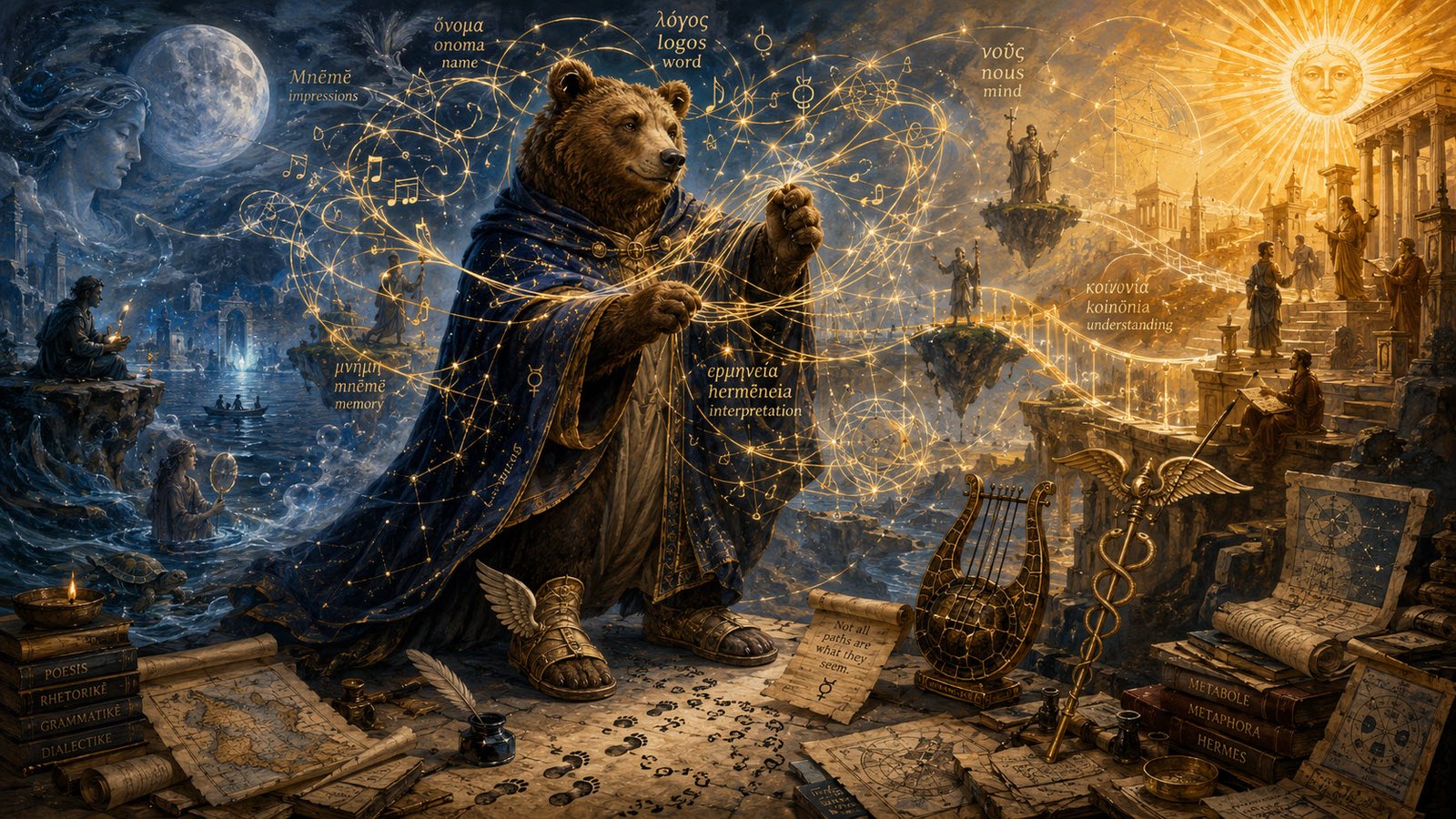
Mercury: The Meaning Weaver
Mercury is the planet of language, perception, connection, and the quicksilver intelligence that helps us make meaning from experience. This reflection explores Mercury not simply as the messenger of the gods, but as the meaning-weaver: the part of us that notices patterns, asks questions, translates between worlds, and turns the raw material of life into thought, speech, story, and understanding.

MERCURY
The Meaning Weaver
On the first night of his life, Hermes escaped from his cradle.
At least, that is how the old story tells it.
While his mother slept, the infant god slipped from his swaddling clothes and went looking for something interesting to do. Before the night was over, he had stolen Apollo’s cattle, disguised their tracks, killed a tortoise, invented the lyre from its shell, composed music upon it, lied about nearly everything, confessed when confronted, and negotiated a profitable settlement with the god he had robbed.
By the end of his first day, Hermes had become an inventor, thief, musician, liar, merchant, messenger, and mediator.
It is difficult to imagine a more Mercurial beginning.
Hermes does not wait patiently for the world to explain itself. He moves toward it, examines what he finds, takes it apart, discovers unexpected relationships, and creates something that did not exist before.
A tortoise becomes a musical instrument.
A theft becomes an exchange.
A quarrel becomes a negotiation.
Mercury is always asking what one thing might have to do with another.
This is why reducing Mercury to a “communication style” misses so much of the symbol’s depth. Mercury certainly includes speaking, writing, listening, and the exchange of information. But beneath all these lies a more fundamental activity.
Mercury is the principle that renders experience intelligible.
It is the weaving intelligence through which what happens to us becomes something we can recognize, consider, name, remember, and share.
From Experience to Thought
Before we can explain an experience, we must first receive it.
This is the work of the Moon.
The Moon absorbs life as atmosphere, sensation, feeling, memory, and bodily response. It knows before it can say what it knows. An infant recognizes warmth, hunger, absence, comfort, and fear long before any of these experiences can be named.
The lunar world is received as a whole.
Mercury begins to divide that whole into recognizable parts.
This is mother.
That is the table.
Here is my hand.
There is the door.
The child points toward something and asks the great Mercurial question:
What is this?
With every answer, the world becomes more differentiated. A sound is connected to an object. One thing is distinguished from its surroundings. Experiences are compared. Categories form. The nameless world begins to take on structure.
A thing that can be named can also be brought to mind when it is absent. It can be asked for, discussed, remembered, praised, feared, and misunderstood.
Naming separates one thing from another, but it also allows the two to be connected again in thought.
Every word is both a boundary and a bridge.
The Moon receives the threads of experience.
Mercury begins to weave them.
The Mind at the Loom
We sometimes speak as though meaning were simply waiting inside events to be discovered, like a coin beneath a cushion.
At other times, we speak as though meaning were entirely invented—as if the mind could impose any interpretation it pleased upon an empty world.
Mercury suggests something more subtle.
Meaning is neither passively received nor freely fabricated. It emerges through the encounter between experience and the mind that attends to it.
The mind distinguishes, compares, remembers, notices repetition, draws conclusions, and imagines what may follow. Two people can live through the same event and understand it differently because they do not weave its elements into the same pattern.
One notices the insult.
Another notices the fear beneath it.
One remembers the failure.
Another remembers what was learned.
One sees coincidence.
Another sees providence.
That does not mean every interpretation is equally true. Some patterns fit the evidence better than others. Some meanings enlarge understanding; others protect us from facts we would rather not face.
Mercury is capable of clarity, but also of rationalization.
It can name reality carefully, or arrange words so cleverly that reality disappears behind them.
The mind is a loom. But a loom can produce a strong fabric, a beautiful one, or something so tangled that no one can use it.
A Creaturely Share in the Word
The opening of the Gospel according to John announces that in the beginning was the Word—the divine Logos through whom all things came into being.
Mercury is not the Logos.
Astrology does not require us to confuse a created planetary symbol with the divine Word. But Mercury may represent our creaturely participation in intelligibility: the human capacity to recognize order, form concepts, and give communicable expression to what we encounter.
We do not create reality by naming it.
But without names, much of reality remains unavailable to reflection.
We do not invent truth.
But we require language, symbol, number, image, and comparison in order to apprehend and communicate it.
Mercury governs this immense family of signs: alphabets, equations, maps, musical notation, gestures, stories, diagrams, prayers, jokes, and astrological glyphs.
The mark itself is not the meaning.
It is the vehicle.
Mercury is the traveller.
The Hand of the Sun
In myth, the fact that the sun-god Apollo is a major player in Hermes’ origin story is not an accident. Mercury never appears very far away from the Sun from our perspective here on earth.
Symbolically, they are equally difficult to separate.
The Sun represents the drive to become: to establish a centre of identity, purpose, and creative direction. Mercury gives that purpose a means of expression.
Imagine an orchestra conductor. The conductor possesses the intention to make music. There is a work to be performed, a tempo to establish, and an interpretation to offer.
But intention alone produces no sound.
The conductor requires a score, gestures, musicians capable of reading the notation, ears capable of hearing the result, and air through which the sound can travel.
All of that belongs to Mercury.
The Sun may will. But it is a Mercury function to articulate.
The Sun radiates what it is.
Mercury names it “I” and places it within the sentence “I am”.
Even the familiar gesture by which we point toward our chest when speaking of ourselves contains both principles.
The heart belongs traditionally to the Sun and the pointing hand belongs to Mercury.
Without Mercury, the Sun possesses being but no means of making itself known. Without the Sun, Mercury may possess endless cleverness, movement, and techniques, but no enduring purpose to serve.
Mercury is the hand of the Sun: the faculty through which identity reaches beyond itself and enters the world.
Crossing the Space Between Us
No person can completely enter another person’s experience.
We may love someone deeply, listen carefully, and exercise great empathy, but we remain distinct centres of consciousness.
There is always a space between us. Mercury governs that space.
When two people share a language, they can compare what they have seen, remembered, desired, and feared. When they do not share one, they begin with gestures and very often with names.
What is your name?
What do you call this?
How do I say thank you?
A first fragile bridge appears.
Hermes travelled freely between Olympus, the earth, and the underworld. He crossed boundaries other gods could not. He carried messages between beings who did not occupy the same realm.
Psychologically, Mercury performs similar crossings.
It moves between sensation and thought, the unconscious and conscious mind, intention and expression, one person’s interior world and another’s.
Mercury is not only the sender, recipient, or message. It is the whole process by which something passes between them.
Conversation is Mercurial.
So are trade, translation, teaching, confession, and storytelling.
Each allows something held within one life to become partly intelligible to another.
Rhetoric: The Shaping of Attention
Mercury does not simply carry messages.
It shapes them.
Whenever we speak, write, teach, preach, advertise, argue, or tell a story, we make choices. We decide where to begin, which facts to include, what order to place them in, which image will make an idea memorable, and what tone will make another person willing to listen.
This is rhetoric.
The word sometimes carries a poor reputation. We dismiss something as “mere rhetoric” when language seems manipulative or empty. But rhetoric itself is not the enemy of truth.
At its best, rhetoric is truth made hearable.
A truth may be accurate and still fail to reach anyone because it has been buried beneath jargon, stripped of human significance, or expressed without regard for the listener. The skilful speaker finds the words, structure, and emotional register through which an audience can receive what is being said.
A teacher must discover how to explain a subject to a beginner. A preacher must do more than repeat a doctrine; the words must enter the moral imagination of the congregation. A physician must communicate the facts of a diagnosis in a way a patient can understand and bear.
Rhetoric, in its nobler form, is an act of service.
It asks:
How can this meaning cross the distance between us?
How can I speak so that what is true becomes intelligible without becoming distorted?
But the same powers can be turned toward darker ends.
A speaker may arrange facts so that technically nothing false has been said while everything important has been concealed. A headline may provoke outrage before the article has been read. A slogan may reduce a difficult reality to a phrase simple enough to repeat and crude enough to divide.
The problem is not always that information has been invented.
Often it has been selected for us: one fact is enlarged; another is omitted; a possibility is described as a certainty; an isolated event is presented as a pattern.
Language directs attention so effectively that we fail to notice what has been left outside the frame. Mercury’s trickster nature lives here.
Hermes reverses the cattle’s tracks so that anyone following the evidence will move in the wrong direction. The tracks are real. The deception lies in their arrangement.
Much modern misinformation works the same way. A quotation is removed from context. A chart begins at a carefully chosen point. An authentic image is attached to the wrong event. A confident voice presents speculation as settled knowledge.
Rhetoric also works through feeling.
Fear narrows attention.
Anger creates urgency.
Flattery lowers resistance.
Belonging makes agreement feel safe.
None of these emotions proves that a claim is false. But neither does emotional intensity prove that it is true.
In an age of ceaseless information, Mercury requires more from us than the ability to read.
It requires discernment.
Discernment asks:
What is this message asking me to notice?
What is it encouraging me to ignore?
Does the evidence support the conclusion?
Can the claim be checked beyond the circle in which I first encountered it?
Am I accepting this because it is true, or because it confirms the story I already prefer?
The answer is not permanent suspicion. A mind that trusts nothing becomes as vulnerable as one that trusts everything. Cynicism may look like discernment, but it often rejects by reflex rather than examining with care.
Healthy Mercury remains open without becoming gullible, and questioning without becoming incapable of conviction.
It checks. It compares. It asks for context.
It is willing to say both, “That claim has not been established,” and, “The evidence has changed my mind.”
Rhetoric reaches its highest purpose when it joins clarity to informed conscience.
Words can inflame a crowd or reconcile opponents. They can disguise cruelty or expose it. They can reduce a person to a category or restore a name to someone who has been treated as a thing.
Mercury’s great power is to shift and shape attention.
Wisdom asks us to use that capacity in service of truth.
The Stories We Tell Ourselves
Some of Mercury’s most consequential speech is never spoken aloud for it occurs within the privacy of thought. There, we narrate our lives continuously.
“I always ruin things.”
“No one listens to me.”
“This is impossible.”
“I survived that.”
“Perhaps I can begin again.”
These sentences do not merely report experience. They organize it. Repeated often enough, they become pathways along which perception habitually travels.
Sometimes an important change begins not with acquiring new information but with finding a more accurate sentence.
Not: I am a failure.
But: Something I attempted has failed.
Not: I am incapable of intimacy.
But: I learned early that intimacy was dangerous, and I am still learning another way.
The second sentence does not deny reality. It describes it more precisely—and precision opens possibilities that condemnation closes.
Mercury’s naming power should never be underestimated. What we name and how we name it becomes available for thought.
What we name carelessly may become harder to see clearly.
Your Mercury Is Not an Intelligence Score
In a horoscope, Mercury does not tell us how intelligent someone is.
Intelligence has many forms, and no sign possesses a monopoly upon it.
Mercury describes something closer to the conditions under which the mind becomes active and the characteristic way it makes connections.
A fire-sign Mercury may be stimulated by possibility, inspiration, and the urge to express a vision.
An earth-sign Mercury seeks what is practical, workable, and useful.
An air-sign Mercury comes alive through ideas, comparison, dialogue, and the relationship between parts.
A water-sign Mercury attends to feeling, atmosphere, memory, imagination, and what is communicated beneath the words.
The modes describe the movement of the weaving. Cardinal Mercury initiates. Fixed Mercury holds and tests. Mutable Mercury adapts and translates.
Each can produce remarkable understanding.
Each also has characteristic ways of becoming trapped.
The horoscope does not divide people into the intelligent and unintelligent. It suggests that minds require different kinds of nourishment and perform their work through different symbolic patterns.
Because Mercury remains so close to the Sun, however, it should rarely be considered in isolation. The question is not only how the mind works, but what centre of life and purpose that mind has been asked to serve.
Weave Well and Weave True
Mercury grows through attention.
Not merely through consuming more information, but through noticing how we turn information into understanding.
What do you repeatedly notice?
Which facts do you dismiss?
What explanations satisfy you too quickly?
Which story about yourself has become so familiar that you no longer examine whether it remains true?
A healthy Mercury is not a mind that never becomes confused.
It is a mind willing to revise its pattern when the old one no longer holds.
It can say:
I misunderstood.
I used the wrong word.
I had not considered that.
Tell me what you mean.
Let us begin again.
These may be among the most intelligent sentences any person can speak.
Mercury is sometimes imagined only as speed: the quick answer, the clever reply, the message delivered before anyone else.
But true mediation also requires patience.
A messenger must receive the message before carrying it.
A translator must listen before speaking.
A mind must sometimes remain with an experience before forcing it into a familiar category.
Meaning is woven not only through movement, but through the pauses in which we look again.
The World Made Shareable
The Moon certainly receives the world. Yet, it is Mercury who first begins to understand it.
It separates the threads, gives them names, discovers their relationships, and weaves them into patterns that can be carried beyond the solitary self.
Through Mercury, experience becomes thought. Thought becomes language. And language becomes a meeting place.
We will never entirely escape misunderstanding. No word perfectly contains the reality it names. No story exhausts the tale it attempts to tell.
But the incompleteness of language does not make it useless.
It makes our use of it an act of humility.
We speak across the distance between us, hoping that something true will arrive.
We listen, hoping to receive more than the words alone.
We revise.
We clarify.
We try another image.
We weave and reweave.
Mercury reminds us that meaning is not a possession held privately inside the mind. It is an activity—a living exchange among perception, memory, language, world, and other people.
The question is not whether your mind will weave.
It already does.
The question is whether it will weave attentively, truthfully, and in service of a life large enough to be shared.
Continue exploring…
For more articles about astrology, faith, meaning, memoir, and the life we share beneath the sky, explore Reflections.