
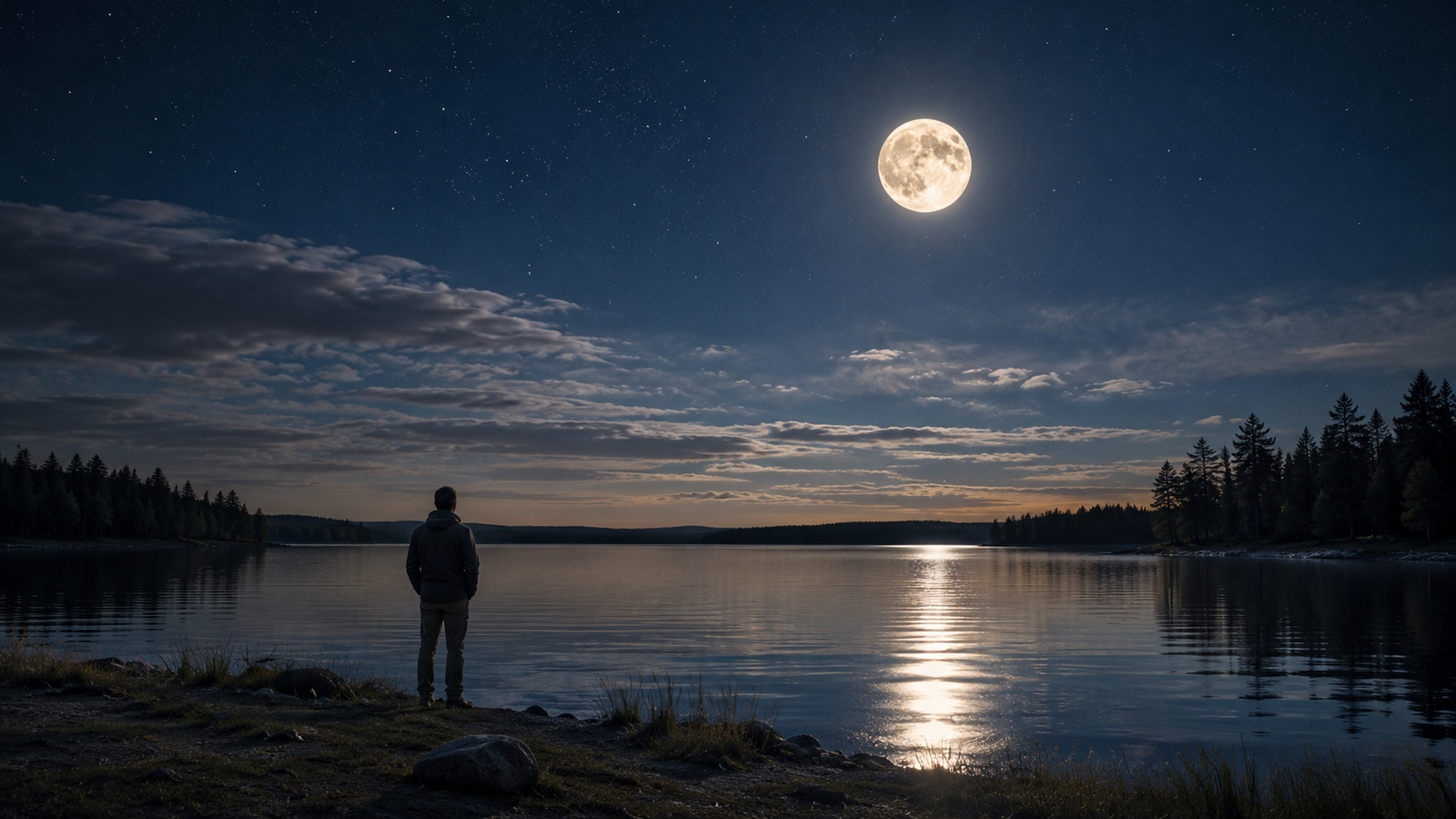
The Discipline of Awe: The Aquarius Full Moon, the Barbault Basket, and a sky too meaningful to be reduced to hype
Astrologers are gushing about the Aquarius Full Moon—and not without reason. It illuminates the Jupiter–Pluto opposition at the heart of the Barbault Basket, one of the year’s most striking configurations. But what if an extraordinary sky invites something deeper than prediction or hype? Perhaps its greater gift is awe: the humility to receive meaning without pretending we can master it.

The Discipline of Awe
The Aquarius Full Moon, the Barbault Basket, and a sky too meaningful to be reduced to hype
Astrologers are gushing.
We do this. Give us several slow-moving planets gathered at nearly the same degrees of their signs, arrange them in an elegant geometric pattern, and we begin reaching for the adjectives normally kept behind glass for emergencies.
Rare. Historic. Transformational. Epoch-defining.
Soon a new age is dawning, the collective is awakening, the old order is collapsing, and humanity stands poised to make an evolutionary leap—possibly before breakfast.
The configuration forming in July 2026 has certainly earned unusual attention. Jupiter in Leo opposes Pluto in Aquarius while forming harmonious relationships with Uranus in Gemini and Neptune in Aries. The pattern has become known as the Barbault Basket, named for the French mundane astrologer André Barbault. Because all four planets gather around the first few degrees of their signs, the geometry is unusually precise.
Some popular accounts have described it as one of the century’s most important alignments, a herald of a new era, or even the beginning of a different world order. Those are substantial claims for four planets that have not yet issued a press release.
And yet the excitement is understandable.
The sky really is remarkable.
The question is not whether this configuration deserves our attention. It does.
The more interesting question is: What kind of attention does it deserve?
An Extraordinary Sky
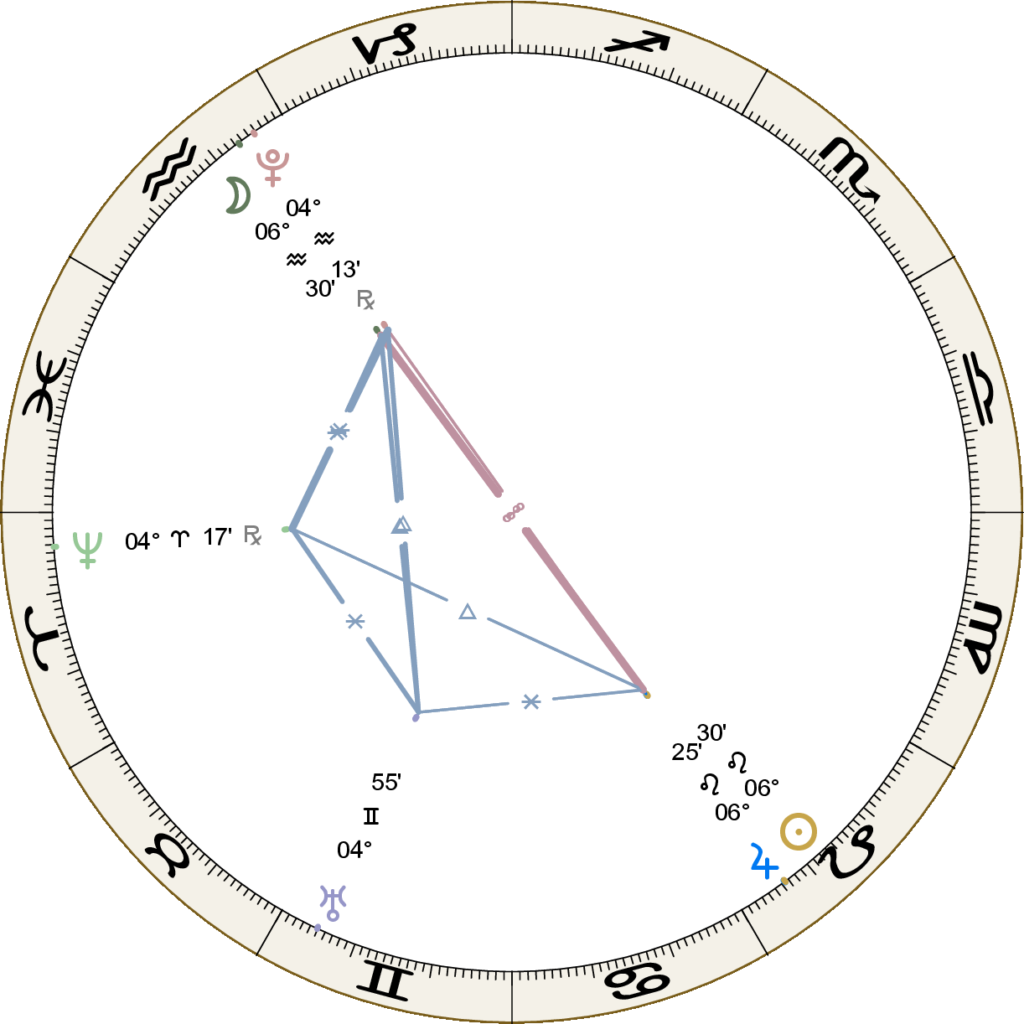
On July 29, 2026, the Moon becomes full at approximately 10:35 a.m. Eastern Time, at 6°30′ Aquarius, opposite the Sun at 6°30′ Leo.
The Sun is almost exactly conjunct Jupiter, while the Moon lies a little more than two degrees beyond Pluto. The Full Moon therefore does not fall precisely upon the Jupiter–Pluto opposition, which perfected on July 20 at approximately 4°26′ Leo and Aquarius. It does, however, unmistakably illuminate and reactivate that axis.
Behind it lies the wider basket: Jupiter in Leo sextile Uranus in Gemini and trine Neptune in Aries; Uranus sextile Neptune and trine Pluto; Neptune sextile Pluto. Jupiter and Pluto form the opposition that opens the pattern and gives it much of its tension. Around the time of their exact opposition, all four planets occupied approximately four degrees of their respective signs.
It is a beautiful piece of celestial architecture.
But beauty is not the same as beneficence. Rarity is not the same as historical importance. Precision does not grant us certainty about what a configuration will become.
A horoscope may describe the symbolic character of a moment. It may reveal tensions, relationships, openings and pressures that deserve contemplation. It does not place the future under glass.
The heavens are not a clockwork vending machine from which sufficiently clever astrologers can extract tomorrow.
Excitement Is Not Awe
Excitement and awe can feel similar. Both enlarge us. Both quicken attention. Both interrupt the ordinary.
But they move in different directions.
Excitement rushes forward.
Something enormous is about to happen.
Awe becomes still.
I am standing before something larger than my ability to comprehend.
Excitement wants to know what the configuration will do. Awe first allows itself to encounter what the configuration is.
This distinction matters because astrologers are interpreters by vocation. We look at a pattern and immediately begin making associations. We compare it with previous cycles. We study nations, inventions, revolutions and cultural movements. We consider how the symbols might find expression in individual lives.
This is part of the craft. Astrology would not be much use if we looked at a horoscope, sighed reverently and refused to say anything about it.
But interpretation carries a temptation. We may begin by entering into relationship with a symbol and end by trying to possess it. Naming becomes explanation. Explanation becomes prediction. Prediction quietly becomes certainty. Before long, history has been assigned its next chapter by someone with an ephemeris and a YouTube channel.
I say this affectionately. I belong to this community. I have been excited by unusual configurations for decades. Place enough planets in an elegant arrangement and I, too, begin behaving as though the cosmos has sent me an engraved invitation.
Hype may even protect us from genuine awe.
Awe leaves us exposed. It asks us to admit that something may be significant without yet knowing its significance. It does not permit us to stand outside the mystery as its master. We must remain within it as participants.
Excitement fills that discomfort with declarations.
Awe stays long enough to listen.
Leo, Aquarius and the Question of Scale
The Leo–Aquarius polarity is particularly suited to this reflection.
Leo is concerned with the singular centre: the creative self, the heart that radiates, the person willing to appear in the world and offer something recognizably their own.
Aquarius turns toward the larger field: community, shared life, social participation, systems, ideals and the patterns connecting one person to many others.
Neither sign is simply individualistic or collective. Each contains a question the other cannot answer alone.
How do I become fully myself without imagining myself to be the centre of everything?
How do I participate in something larger without surrendering the dignity and responsibility of being a particular person?
With the Sun and Jupiter together in Leo, the image of personal radiance becomes enlarged. Jupiter may suggest confidence, generosity, vision and magnanimity—the capacity to live from a heart spacious enough to encourage life in others.
It may also suggest inflation.
The light grows so large that we mistake visibility for importance, confidence for wisdom, or personal conviction for cosmic endorsement. We may believe that because we feel enlarged, everything around us must have been arranged to confirm our enlargement.
Across the sky, the Aquarian Moon draws close to Pluto.
Pluto can bring us into contact with forces that do not submit easily to personal will: inherited patterns, collective pressures, systems of power, historical movements and depths of feeling that cannot simply be managed through positive thinking.
Near the Moon, Pluto may evoke an emotional encounter with scale. The individual discovers that collective life is not an abstraction. We are shaped by communities, technologies, institutions and histories that began before us and will continue after us.
This can be frightening. It can also be liberating.
We matter, but we are not the measure of everything.
That may be the developmental invitation contained within this Full Moon.
Leo is reminded that personal radiance is not the same as cosmic centrality. The Sun does not apologize for shining, but neither does it need every other light extinguished to prove its existence.
Aquarius is reminded that belonging to the whole does not erase the individual. Humanity is not served by turning people into units, categories or representatives of an idea. Every collective is composed of singular lives, each carrying a dignity that cannot be reduced to usefulness.
Awe holds both truths.
My life is small before the immensity of the cosmos.
My life is also real, particular and entrusted to me.
Interpretation at the Edge of Mystery
Astrology offers a disciplined way of dialoguing with meaning.
A horoscope gives form to time. It shows us that a moment is not merely an empty container into which events happen to fall. Each moment has texture, tension, atmosphere and symbolic architecture.
But the chart can give form to a moment without enclosing its meaning.
This is where astrology approaches the edge of mystery.
We can say that Jupiter opposite Pluto evokes questions of expansion and power, conviction and compulsion, magnificence and excess. We can notice that Uranus and Neptune appear to mediate that opposition through images of invention, imagination, disruption and vision.
We can observe that the Full Moon draws these larger themes into the Leo–Aquarius question of individual and collective life.
Then we must watch.
Not because symbols mean nothing, but because they mean more than any single interpretation can contain.
A symbol is not a code with one correct translation. It is a field of relationships. It may appear through presence, absence, inversion, exaggeration, imitation or resistance. Two people may meet the same symbolic pattern and respond in profoundly different ways.
The chart does not compel the response.
That is why meaningful astrology requires more than technical proficiency. It requires patience, self-awareness and humility. We must learn to distinguish between what the symbolism suggests and what our desires, fears or ideologies have recruited it to endorse.
A meaningful sky is not necessarily a sky we can master.
Its meaning is received through relationship. It unfolds through attention, experience and response. We do not manufacture it, but neither do we possess it whole.
The Discipline of Awe
We often think of awe as something that happens to us unexpectedly.
We see the Milky Way from a truly dark place. We stand beside an ocean or beneath a cathedral vault. We encounter a birth, a death, a work of art or an act of courage that exceeds our ordinary categories.
For a moment, the boundaries of the self loosen. The world becomes larger, stranger and more alive.
But awe can also become a discipline.
It can be practised through the quality of attention we bring to what exceeds us.
The discipline of awe does not ask us to stop interpreting. It asks us to interpret without confusing our words with the mystery they approach.
It asks us to look before declaring, to listen before recruiting the moment into a theory, and to allow a symbol to work upon us before deciding what it must mean for everyone else.
It asks us to resist the strange modern assumption that anything valuable must become immediately useful, shareable and certain.
This is not intellectual surrender. Awe does not require us to abandon discernment or accept every extravagant claim dressed in celestial language. Quite the opposite. Reverence makes precision more important, not less.
If the sky is meaningful, we should not need to exaggerate it.
If a configuration is powerful, it does not require us to advertise it as omnipotent.
If something new is emerging, we need not pretend to know its final form while it is still struggling toward birth.
Awe permits expectancy without entitlement.
Something significant may indeed be stirring in the collective imagination. New relationships among technology, community, authority and personal creativity may be seeking expression. Old structures may be revealing their limits. Human beings may be discovering unfamiliar ways of participating in a changing world.
Or history may manifest these symbols through developments none of us has yet imagined.
The task is not to become less attentive to the sky.
It is to become less hurried in our possession of it.
Beneath the Full Moon
The Aquarius Full Moon will reach its exact opposition during daylight in Toronto. We will not see the moment itself. By evening, however, the Moon will rise carrying the fullness of what has already occurred.
That, too, seems fitting.
Much of what shapes a life happens before we can name it. Meaning gathers below the horizon. Only later does it rise into visibility.
So perhaps we might meet this Full Moon without demanding a revelation from it.
We might step outside, if the sky permits. We might notice the Moon’s borrowed light and remember that illumination is often relational. The Moon shines because it receives.
We might consider where we have mistaken excitement for understanding, visibility for significance, or membership in a movement for freedom from personal responsibility.
We might ask where our own lives are being invited to grow larger—and where we must become smaller, quieter or more receptive in order to recognize what is already present.
The heavens may indeed be saying something.
Astrology gives us ways to listen. It teaches us to recognize patterns, honour correspondences and participate more consciously in the life of time.
But listening is not the same as already knowing what will be said.
Some skies do not ask to be explained more loudly.
They ask us to become quiet enough to receive them.
Continue exploring…
For more articles about astrology, faith, meaning, memoir, and the life we share beneath the sky, explore Reflections.