
The Sun: A Radiant Centre Beyond Personality
Each morning, the Sun restores the visible world.
Things emerge from darkness. Distances become perceptible. Paths appear. What had been hidden acquires shape, colour, and direction. The Sun does not merely illuminate the landscape; it makes orientation possible.
Astrologically, the Sun performs a similar function within the horoscope. It is the centralizing principle: the power through which a life gradually becomes coherent, intentional, and distinctly its own.

THE SUN
A Radiant Centre Beyond Personality
Each morning, the Sun restores the visible world.
Things emerge from darkness. Distances become perceptible. Paths appear. What had been hidden acquires shape, colour, and direction. The Sun does not merely illuminate the landscape; it makes orientation possible.
Astrologically, the Sun performs a similar function within the horoscope. It is the centralizing principle: the power through which a life gradually becomes coherent, intentional, and distinctly its own.
The Sun is often reduced to personality, particularly in popular descriptions of Sun signs. But personality is too big a concept for what the Sun represents. Personality includes habits, preferences, reactions, social mannerisms, and ways of adapting to our surroundings. Much of that belongs elsewhere in the horoscope.
The Sun concerns something more fundamental.
It represents the will to exist as a distinct person—to gather the developing faculties of the self and direct them toward a life that can be consciously claimed and enacted.
The Sun asks: what are you here to embody?
The answer is not given all at once. The Sun describes a trajectory rather than a finished identity. It is less what we already possess than what we must gradually bring into being.
From Safety to Adventure
The Moon and Sun describe two indispensable movements of human development.
The Moon governs belonging, familiarity, memory, protection, and the instinctive patterns through which life is preserved. Its first concern is safety. The lunar world asks:
Where am I held? What will nourish me? Where can I return when the world becomes too much?
The Sun introduces another question:
What might I become if I venture beyond what is already familiar?
These movements need not be divided according to gender. The Sun is not inherently male, nor is the Moon inherently female. In many families, one parent may be more immediately alert to safety, continuity, and protection, while another more readily encourages exploration, experimentation, and manageable risk. Either parent may carry either function, and both functions may be present within the same person.
One parent sees how high the child has climbed and imagines the fall.
The other sees the child looking upward and says, “Try the next branch. I’m here.”
Both responses are expressions of care.
The lunar function protects the child from dangers they cannot yet assess. The solar function helps the child discover that uncertainty is not always the same as peril. It teaches that a measure of risk may contain discovery, competence, mastery, and delight.
This is why the Sun depends upon the Moon rather than opposing it. The child can venture farther because there is somewhere safe to return. Security becomes the ground from which courage can grow.
The Moon says, “You are safe here.”
The Sun says, “You can go farther.”
Without sufficient lunar security, risk may become frightening, compulsive, or reckless. Without the solar invitation to venture outward, safety may gradually become confinement.
The Protagonist of a Life
The Sun is the protagonal principle of the horoscope.
A protagonist is not simply the most visible character in a story. The protagonist is the person whose choices move the story forward.
Every life begins within circumstances it did not choose: a particular body, family, culture, history, temperament, and range of possibilities. Much of this belongs to the lunar world of inheritance, adaptation, and belonging. We first learn how to survive within the world into which we have arrived.
But at some point, the person must begin to act within that inheritance rather than merely receive it.
Developmentally, this becomes especially visible during adolescence and early adulthood. The young person begins to differentiate from the familial world. Inherited roles are examined. Authorities are questioned. New allegiances are formed. One experiments with appearance, vocation, relationship, conviction, and desire.
The question of identity becomes unavoidable.
This can be an awkward and theatrical period because the emerging self needs witnesses. The young person does not merely want to exist privately. The developing identity wants to be seen, acknowledged, and taken seriously.
There is nothing inherently shallow about this need for recognition. We often discover ourselves partly through being recognized by others. Someone notices a capacity in us before we know how to name it. Someone responds to our humour, intelligence, courage, creativity, beauty, or leadership, and their response helps bring that quality into consciousness.
But recognition is meant to call the emerging self forward, not manufacture it.
When solar development becomes dependent upon applause, identity is surrendered to the audience. We begin performing whatever version of ourselves receives the greatest response. Visibility replaces authenticity.
The mature Sun does not ask:
What must I become so that everyone will admire me?
It asks:
What is mine to embody and contribute, whether or not everyone understands?
“Know Thyself”
A memorable expression of the solar journey appears in The Matrix.
Neo visits the Oracle because he wants an answer to the question that has come to dominate his life: is he the One?
Above the Oracle’s kitchen doorway are the words Temet nosce—“Know thyself.”
Yet the Oracle does not simply confer an identity upon him. She does not settle the matter by handing him an authoritative description of who he is. Instead, she confronts him with his own uncertainty and leaves him with a choice that will eventually require courage, sacrifice, and risk.
Neo comes to know who he is by acting.
This is profoundly solar.
Self-knowledge is not merely the accumulation of accurate descriptions about oneself. There are truths we cannot know fully until we have consented to embody them. Courage becomes known when something is risked. Fidelity becomes known when departure would be easier. Vocation becomes known when possibility gives way to commitment.
Neo does not become the protagonist because someone announces that he is special. He becomes the protagonist by making the choice that moves the story forward.
The same principle applies within an ordinary human life. Others may recognize what is emerging in us. A parent, teacher, friend, therapist, spiritual director, or astrologer may name a capacity or possibility that we have not yet claimed. Their recognition can matter enormously.
But no oracle can live the life for us.
The Sun cannot be bestowed by external validation. Eventually, the person must choose from the centre of their own life.
The solar question is therefore not simply:
Who am I?
It is:
What choice becomes possible once I begin to know what I am?
The Call Beyond the Familiar
Joseph Campbell’s description of the hero’s journey offers another way of understanding the solar pattern.
The protagonist begins within a familiar world. A call arrives. Something beyond the established order demands a response. The call may initially be refused because the known world, however limited, still offers security.
But the journey cannot unfold until the threshold is crossed.
Trials follow. The protagonist encounters resistance, discovers allies and adversaries, loses old certainties, and undergoes some transformation. The person who returns is not identical to the person who departed.
Solar development follows a similar movement.
Something must be attempted. Some boundary must be crossed. A role, expectation, or borrowed identity eventually proves too small. The person encounters resistance—from family, society, circumstance, failure, fear, or some division within the self.
This does not require a spectacular adventure. Most solar journeys unfold within ordinary life.
A person leaves an inherited expectation and discovers a vocation.
Another risks being known truthfully within a relationship.
Someone undertakes work for which they do not yet feel ready.
Another survives failure and returns with greater humility.
Someone who has spent years adapting to others finally makes a consequential choice of their own.
The struggle is not incidental to solar development. It is through meeting resistance that intention becomes character.
The solar journey is also not a single heroic episode completed in youth. It repeats whenever life asks us to relinquish an identity that has become too small and consent to further development.
The call may come at twenty, forty, seventy, or several times within the same life.
The Freedom to Become What One Is
Solar freedom is not the power to become absolutely anything.
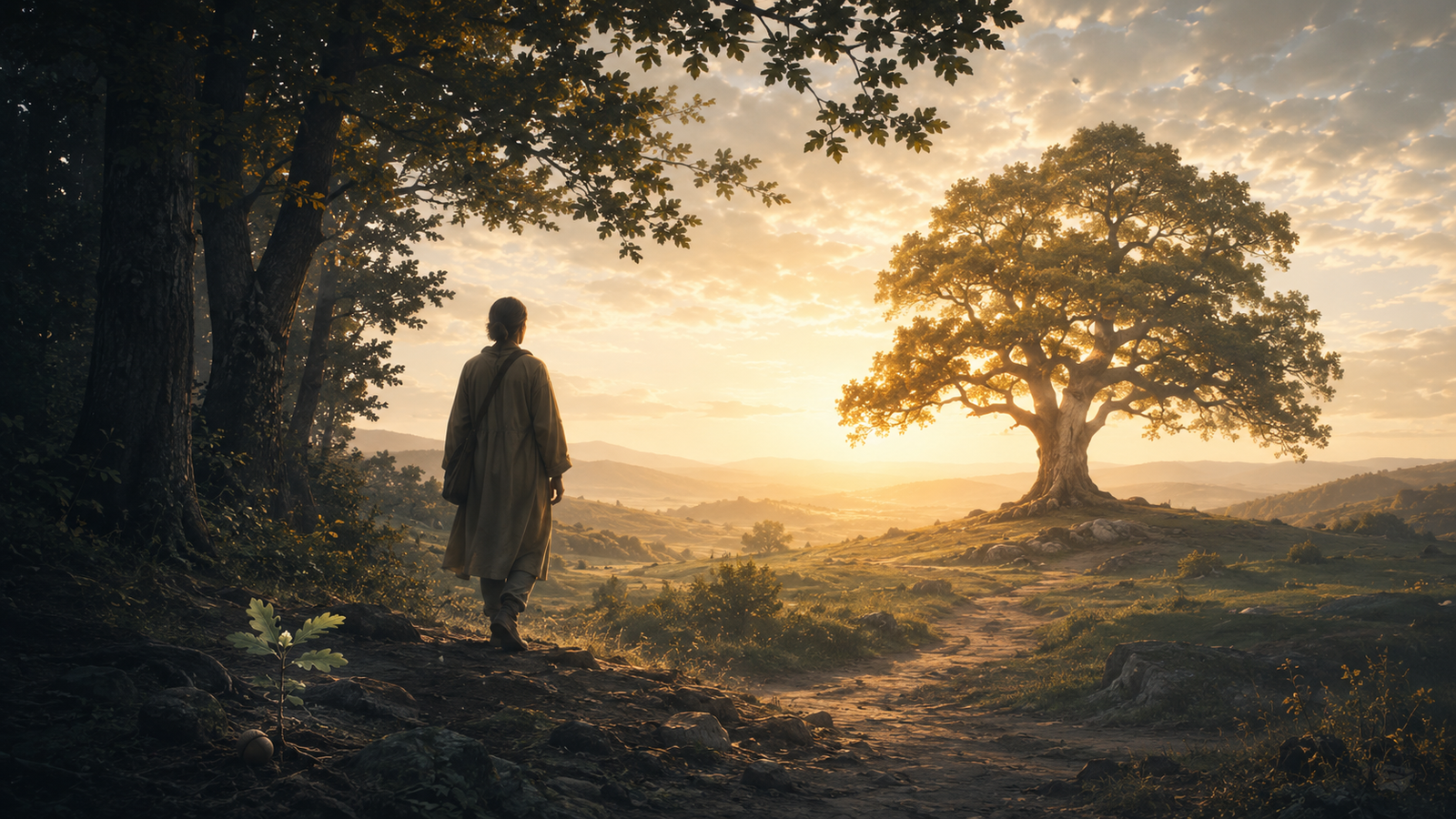
An acorn contains a particular promise. It cannot become a willow, a rose, or a field of wheat. If it grows, it will grow toward the form of an oak.
Yet no two oak trees are identical.
One takes root in open ground and spreads a great, symmetrical crown. Another grows at the edge of a forest, reaching sideways toward the available light. One is shaped by prevailing winds. Another grows around stone. A tree rooted in poor soil may remain small and resilient; one planted beside abundant water may become immense.
Storms break branches. Seasons of drought drive roots deeper. Human hands may prune, protect, neglect, or damage the tree.
The underlying form remains recognizably that of an oak, but the life that embodies it is singular.
So it is with the Sun.
The Sun does not describe an identity imposed upon life from the outside, nor a personality assembled according to preference. It represents an inner direction of growth: a form seeking realization through the particular circumstances of a life.
Jung is often credited with the observation that freedom of will is the ability to do gladly what one must do. Whether treated as a direct quotation or as a paraphrase of his thought, it expresses something essential about the Sun.
Freedom does not always mean escaping necessity. At its deepest, it may mean recognizing the necessity that belongs to one’s own nature and consenting to it consciously.
The solar question is not:
What could I make myself become?
It is:
What is seeking to become conscious and embodied through me?
This is not fatalism. An acorn may contain the form of an oak, but it does not contain a diagram of every branch.
The Sun establishes direction, not a predetermined script. It does not dictate a profession, guarantee an achievement, or exempt anyone from moral choice. It describes the principle around which choices can acquire coherence.
We do not first know completely what we are and then begin to live it. We come to know what we are through the struggle of living it.
Neo must make the choice before he fully understands the identity the choice reveals.
The oak must grow before its particular form can be seen.
Authenticity & Form
Modern culture often presents authenticity as unlimited personal autonomy: discover what you want, cast off every inherited claim, and invent yourself according to your own design.
The Sun certainly asks for differentiation. It requires us to distinguish genuine conviction from conformity, vocation from expectation, and conscious choice from habitual adaptation.
But solar development is not the creation of a self from nothing.
We receive a life before we direct it.
We inherit a body, family, history, language, culture, temperament, capacities, limitations, relationships, and circumstances we did not choose. Freedom begins within this given reality.
We cannot choose every condition under which we grow, but we participate in what those conditions become within us.
We may reach toward the light or remain turned away from it.
We may respond to injury through bitterness or depth.
We may cultivate a capacity or neglect it.
We may accept the discipline our development requires or spend years resisting it.
The struggle of the protagonist is therefore not a battle against all limitation. It is the struggle to distinguish between limitations that prevent growth and the necessary form through which growth becomes possible.
A river is not made less itself by having banks. Without them, it would cease to be a river and become a flood.
In the same way, solar identity requires form. Commitment excludes other possibilities. Vocation asks something particular of us. Character develops through repeated choices.
To become one person means relinquishing the fantasy of being every possible person.
Authenticity is therefore not unlimited self-invention. It is fidelity to the life that has been entrusted to us.
The Sun, Temperament, and the Four Seasons
According to traditional astrology, the Sun also is a component of personal temperament through its position within the annual cycle. This seasonal contribution does not replace the sign’s element, nor does it determine the temperament of an entire horoscope. It provides one important strand within a much larger pattern.
Spring: The Sanguine Sun
Aries, Taurus, and Gemini
Spring is warm and moist: the conditions under which life germinates, spreads, and multiplies.
The spring Sun contributes a sanguine quality—hopeful, responsive, experimental, and inclined toward movement. Something is beginning, and the world appears full of openings.
The spring Sun approaches existence as an invitation.
Summer: The Choleric Sun
Cancer, Leo, and Virgo
Summer is hot and dry. Light reaches its greatest strength, growth becomes concentrated, and life presses toward fullness.
The summer Sun contributes a choleric quality—purposeful, expressive, productive, and capable of sustained application.
The summer Sun seeks to bring something to maturity.
Autumn: The Melancholic Sun
Libra, Scorpio, and Sagittarius
Autumn is cool and dry. The light begins to withdraw. Boundaries sharpen, fruit separates from the branch, and the work of harvest requires judgment.
The autumn Sun contributes a melancholic quality—not merely sadness, but discernment, gravity, selectivity, and awareness of consequence.
The autumn Sun asks what is worth preserving.
Winter: The Phlegmatic Sun
Capricorn, Aquarius, and Pisces
Winter is cold and moist. Visible activity diminishes, but life has not vanished. It has withdrawn beneath the surface, conserving its strength and awaiting another beginning.
The winter Sun contributes a phlegmatic quality—receptive, enduring, contemplative, and capable of living through periods in which growth is not yet visible.
The winter Sun keeps faith with hidden life.
Conclusion
These seasonal qualities reveal why Sun signs cannot be understood through element alone. A Cancer Sun receives the concentrated force of summer, just as an Aquarius Sun carries something of winter’s inwardness and conservation.
The horoscope preserves several layers of symbolism at once. For more, see:
For information about the signs, explore the Zodiac.
When the Sun Falters
An underdeveloped Sun may remain hidden behind adaptation.
It waits for permission. It borrows identity from stronger personalities. It allows caution to become an excuse for never entering the world. It may secretly long to be recognized while refusing every risk through which recognition could occur.
Such a person may remain at the threshold of the journey, endlessly preparing for a departure that never comes.
An inflated Sun has the opposite difficulty.
It confuses distinction with superiority, authority with control, and radiance with constant attention. It demands that everything orbit around its needs. It becomes less interested in embodying a life than in maintaining an image.
Both difficulties arise from a failure of genuine solar development.
The hidden Sun fears becoming visible. The inflated Sun fears becoming ordinary.
But the purpose of the Sun is not domination, celebrity, or applause.
The physical Sun gives light without requiring the flowers to praise it. In the same way, a mature solar presence does not make every room smaller so that it can appear larger. It provides warmth, direction, vitality, and courage.
Its self-possession allows other people to become more fully themselves.
The healthy Sun neither hides nor overwhelms.
It shines.
The Risk of a Life That Is One’s Own
Every genuine act of self-expression contains risk.
To speak in one’s own voice is to risk disagreement.
To love is to risk rejection.
To create is to risk failure.
To accept a vocation is to relinquish other possible lives.
To become visible is to surrender control over how one will be perceived.
The Moon naturally reminds us of everything that could go wrong. Its caution protects us from dangers we have encountered before.
The Sun answers that a life devoted entirely to avoiding danger eventually avoids life itself.
Solar courage need not be dramatic. It may appear in the quiet decision to stop imitating, to name a conviction, to undertake meaningful work, to accept responsibility, or to allow oneself to be known.
The Sun does not require us to become celebrities. It asks us to become present.
Nor does becoming the protagonist mean controlling the entire story. No one authors circumstance, other people, mortality, or providence. Solar agency exists within a reality that remains larger than the individual will.
The mature Sun therefore does not proclaim: I can make life become whatever I desire.
It says:This is the life I have been given. How shall I answer it?
The answer must be enacted rather than merely imagined.
That is the Sun’s particular demand. It calls the person out of passive possibility and into the risks of embodiment.
The Oracle can point toward the inscription.
An astrologer can describe the pattern.
A parent can encourage the next step.
A teacher can recognize the emerging gift.
But eventually, each individual must cross their own threshold.
The Sun is the radiant centre because it gathers the scattered possibilities of a life and calls them into expression. It invites us beyond the safety of what we already know, while remaining faithful to the form of life entrusted to us.
The Moon reflects where we belong.
The Sun reflects the person to become.
Continue exploring…
For more articles about astrology, faith, meaning, memoir, and the life we share beneath the sky, explore Reflections.