
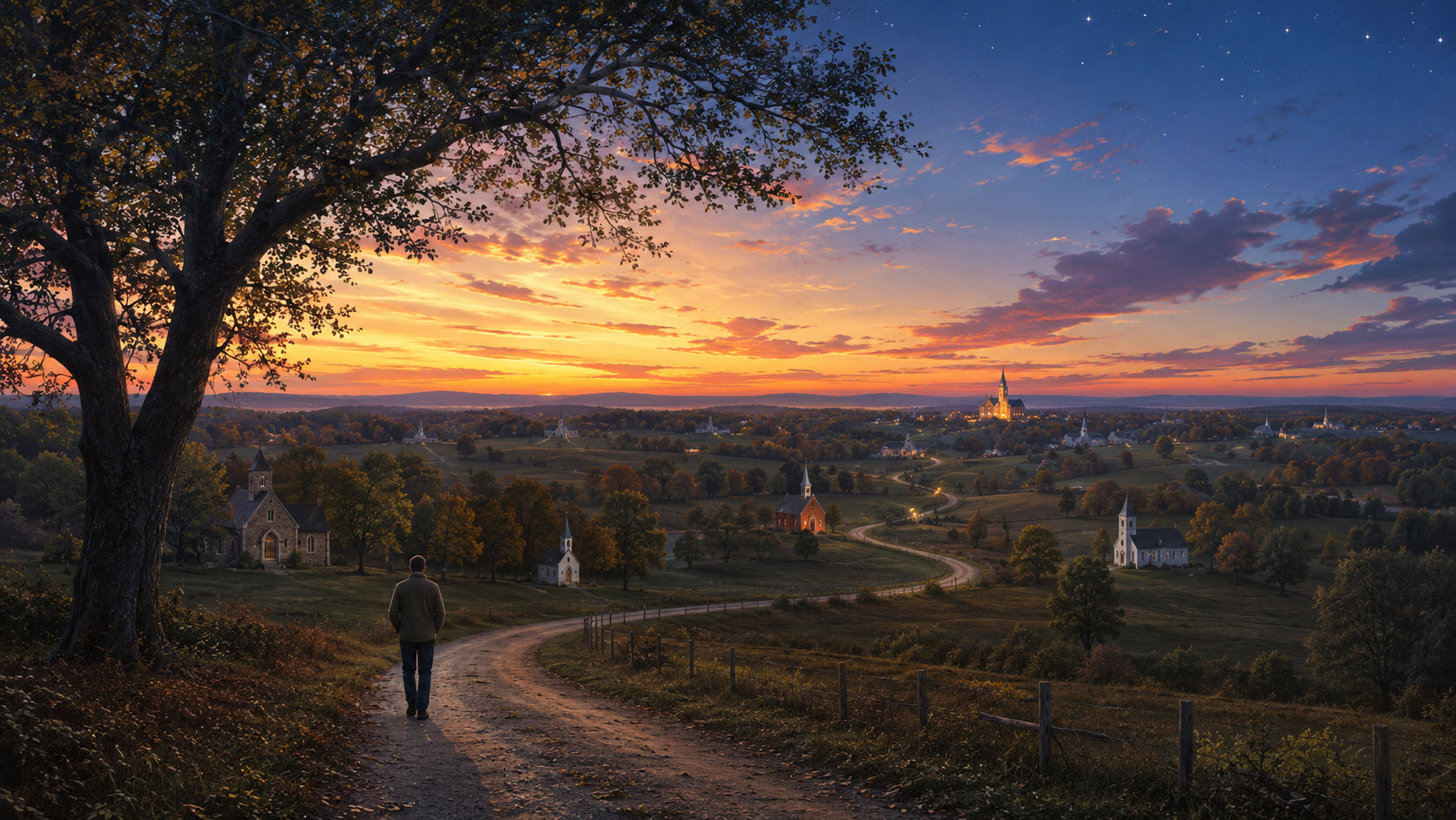
A Town Full of Churches: Where Many Paths Became One
As I prepare to attend the 14th Anniversary Mass of All Inclusive Ministries, I find myself reflecting on a path no one could have predicted—and on all the churches that helped shape it. If someone had told the boy I once was that he would one day become a Catholic, help establish an LGBTQ Catholic ministry, and spend decades as a professional astrologer, I would have found it utterly improbable.

A TOWN FULL OF CHURCHES
Where Many Paths Became One
As I prepare to attend the 14th Anniversary Mass of All Inclusive Ministries at Our Lady of Lourdes on June 27th at 7:00 p.m., I find myself reflecting on a path that no one could have predicted—not even me. And all the churches that contributed to it.
If someone had told the boy I once was that he would one day become a Catholic, help establish an LGBTQ Catholic ministry, and spend decades working as a professional astrologer along the way, I would have found the whole thing improbable.
Yet looking backward, I can see the fingerprints of grace everywhere.
I grew up in Kemptville, Ontario, a small town south of Ottawa. The town itself was unremarkable in many ways, but one thing stood out: churches seemed to be everywhere.
There were Presbyterians and United Church members across the street from one another. Methodists around the corner. Anglicans at St. James. Pentecostals, the Salvation Army, Jehovah’s Witnesses, and, further out of town, the local Catholic parish. Years later, I learned there had even been a small synagogue hidden near the downtown core.
My father did not drive, and church loyalty was not one of his stronger qualities. He church-shopped. As a result, I received at least a brief introduction to many of these communities.
At the United Church, I remember making a Star of Bethlehem from toothpicks and glue during Advent. At the Presbyterian church, I learned “They’ll Know We Are Christians By Our Love” and sang it all the way home afterward. At a Methodist Bible study, I memorized John 3:16. At a Pentecostal gathering, I encountered “Lord of the Dance” and became so captivated by it that I sang it repeatedly while wandering the western edge of town at sunset, watching the countryside dissolve into evening.
Something about Christianity already spoke to me.
Not through doctrine.
Through wonder.
At the same time, another inheritance was forming.
My mother and I shared more than either of us understood at the time.
We both lived with the same mood disorder. We both possessed restless curiosity. We both were fascinated by questions of meaning, imagination, and spiritual experience.
During the years following my younger brother’s serious illness, my mother became involved with one of the many meditation movements that flourished during the 1970s. What followed was a devastating manic episode that led to hospitalization and eventually a diagnosis of Bipolar I Disorder.
When she emerged from that experience, she carried with her a dream of a golden fish encountered in dark waters. She associated it with Christ and decided to return to the Anglican Church of her childhood.
That decision changed our family.
My mother joined the choir at St. James Anglican Church. Family life gradually stabilized. Years later, my brother and I were confirmed there after memorizing the Ten Commandments, the Lord’s Prayer, and the Apostles’ Creed.
What left the deepest impression on me was not Anglican theology.
It was participation.
I learned to sing in a choir. I became familiar with liturgy. I discovered what it felt like to belong to a worshipping community.
Those experiences would prove invaluable decades later when I first attended a Catholic Mass.
Yet Anglicanism did not replace my mother’s wider interests. The family bookshelves continued to hold both Christian and New Age materials side by side. Astrology. The I Ching. Tarot. Psychology. Self-help. Spiritual exploration.
As a teenager, I inherited all of it.
I never perceived a contradiction.
I stood with one foot in each world.
For many years, astrology became the dominant path. What began as curiosity matured into study, then vocation. I spent decades exploring symbolism, mythology, history, psychology, and the ways human beings seek meaning in their lives.
Yet something unexpected happened along the way.
The deeper I explored the symbolic imagination, the more questions I found myself asking about truth, goodness, purpose, and the nature of reality itself.
Those questions eventually led me toward Catholicism.
Not through rejection of everything that came before.
Through re-examination.
The faith I encountered in the Catholic tradition did not ask me to abandon wonder. It asked me to place wonder within a larger framework.
The symbolic imagination was not destroyed.
It was purified.
The cosmos remained meaningful.
But meaning belonged ultimately to God.
What once appeared to be competing paths slowly revealed themselves as stages of a single journey.
The churches of my childhood.
My mother’s return to Anglicanism after her breakdown.
The books on our shelves.
The years spent studying astrology.
The search for wisdom.
The longing for meaning.
The desire to understand human lives more deeply.
All of it became material for grace.
Today, as I prepare to celebrate fourteen years of All Inclusive Ministries, I find myself filled less with certainty than gratitude.
Gratitude is not naïveté.
Life has contained suffering, confusion, mistakes, illness, loss, and more than a few detours.
Yet gratitude allows us to perceive something that despair often misses: goodness has been present too.
Friendships.
Teachers.
Communities.
Music.
Books.
Sacraments.
Unexpected encounters.
Moments of beauty.
The simple fact that one can recognize these things at all is itself a grace.
Looking back, I do not see a straight line.
I see a winding road.
A road through churches, books, questions, breakdowns, recoveries, friendships, and discoveries.
A road I never would have designed.
A road I would not now exchange.
And so I find myself grateful—for my mother, for the faith she rediscovered, for the traditions that shaped me, for the questions that refused to leave me alone, and for the Church that eventually became my home.
Most of all, I am grateful that God seems able to write with crooked lines.
Because some of us have given Him plenty to work with.
Continue exploring…
For more articles about astrology, faith, meaning, memoir, and the life we share beneath the sky, explore Reflections.