
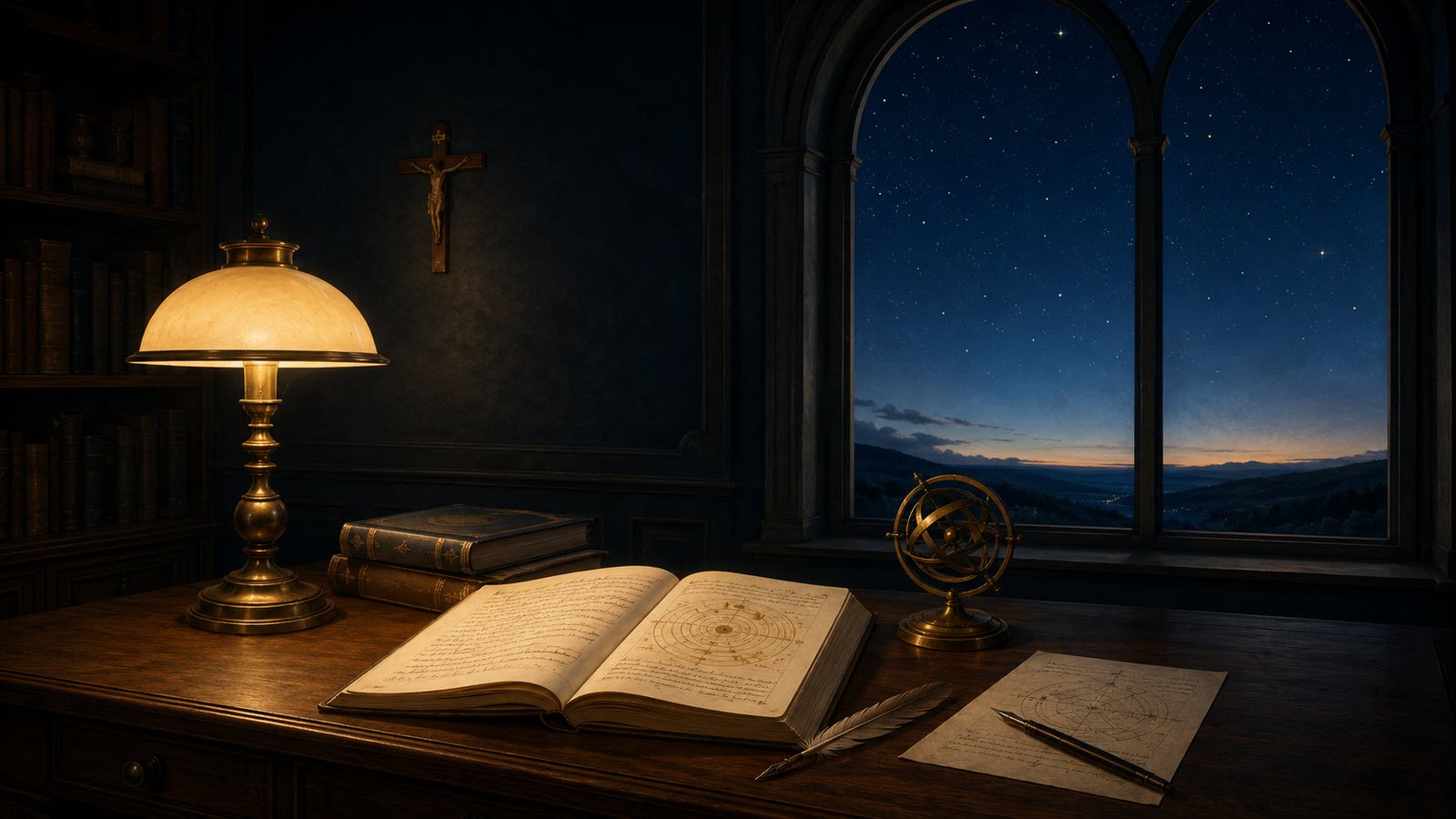
Astrology’s Purpose: Dialoguing with Meaning
Astrology is often mistaken for prediction, but its deeper purpose is conversation: a way of dialoguing with meaning, listening to the patterns of time, and meeting our lives with greater self-understanding, freedom, and awareness.

ASTROLOGY’S PURPOSE
Dialoguing with Meaning
Astrology is once again having a cultural moment.
A recent Pew Research Center survey found that nearly three in ten American adults consult astrology, horoscopes, tarot cards, or fortune tellers at least occasionally. Most say they do so for entertainment, but a substantial minority look to these practices for genuine insight. Younger adults, women, and LGBTQ+ people are particularly likely to engage with them.[1]
Meanwhile, a major Canadian magazine recently announced that astrology had become “the new therapy.” Astrology apps promise psychological insight, relationship guidance, mindfulness exercises, daily forecasts, and notifications timed to the movements of the planets. On TikTok and Instagram, brief declarations about signs, transits, compatibility, trauma, manifestation, and destiny pass through the hands of an algorithm before arriving in ours.[2]
Astrology has become easier to access than at any other time in history. It has also become harder to define.
The word now covers everything from serious study to passing amusement: ancient techniques, newspaper horoscopes, psychological reflection, political prediction, relationship compatibility, wellness rituals, memes, automated readings, and spiritual advice generated by artificial intelligence.
Some of this work is thoughtful. Some of it is playful. Some of it meets a real human need to feel seen, named, and accompanied. Some of it is little more than content wearing a celestial costume.
So perhaps I should say plainly what astrology is for me.
Astrology Reflects A Meaningful Cosmos
Astrology begins, for me, with a philosophical conviction: the universe is not meaningless.
Creation is neither divine nor dead. The stars are not gods, but neither are they merely decorative points of light scattered across an indifferent void. The heavens belong to an ordered creation, sustained by a wisdom greater than our own.
This is why I describe astrology as a symbolic cosmology.
Astrology is not simply a collection of techniques for extracting information from a birth chart. It is a way of contemplating the relationship between a human life and the larger order within which that life appears.
The horoscope is a symbolic picture of a moment. It does not explain a person as a machine might be explained by taking it apart. It places a life within patterns of time, relationship, development, tension, possibility, and meaning.
That distinction matters.
In the modern imagination, something is often assumed to be meaningful only if it can be shown to operate through physical causation. Either the planets make things happen to us, or astrology must be meaningless.
I do not accept that choice.
Human beings already inhabit worlds of meaning that cannot be reduced to physical mechanism. A wedding ring is metal, but not merely metal. A flag is fabric, but not merely fabric. Bread and wine are material realities, but within Catholic life they can bear a meaning that exceeds their chemical composition.
Symbols do not need to push us around in order to disclose something real.
For me, the heavens signify. They do not compel.
The Chart Is Not a Sentence
The old saying that the stars incline but do not compel remains essential to my practice.
A horoscope may describe inclinations, pressures, gifts, vulnerabilities, recurring conflicts, and characteristic ways of meeting life. It may reveal something about temperament, relationship, vocation, authority, desire, responsibility, and the seasons through which a person is passing.
It does not remove freedom.
No one gets to say, “I behaved badly because Mars made me do it.” No one is condemned to emotional immaturity because of the Moon’s placement. No one is excused from developing courage, prudence, justice, temperance, fidelity, or compassion because a chart appears difficult.
A good astrological interpretation should increase responsibility rather than diminish it.
It should help us recognize the material with which we have been given to work. It may show where effort comes naturally and where character must be developed through patience, suffering, practice, grace, and repeated choice.
This is one reason I resist treating the signs primarily as personality types.
Being born under a certain sign does not automatically make a person anything. An Aries Sun does not manufacture courage. A Libra Sun does not guarantee fairness. A Pisces Sun does not bestow compassion without cost.
A sign indicates a way that a planet or other point tends to express itself, and in the case of the Sun, its sign represents a path of growth into becoming who one is meant to be. Its qualities must be cultivated. Its deficiencies must be confronted. Its counterfeits must be distinguished from its virtues.
Every sign also appears somewhere in every horoscope. The zodiac is not a shelf containing twelve different kinds of people. It is a complete circle of human possibility in which all of us participate.
More Than Celestial Personality Testing
Contemporary astrology often functions like other systems of personal classification.
People announce their Sun, Moon, and rising signs alongside their Myers-Briggs type, Enneagram number, attachment style, or Hogwarts house. Astrology becomes another vocabulary for answering the question: What kind of person am I?
Research published in 2025 found that many members of the public use astrology as a marker of identity, entertainment, and self-understanding—something culturally similar to a personality indicator. Professional astrologers and their clients, however, are more likely to understand it as part of a complex spirituality or as an aid to discernment and decision-making.[3]
There is nothing inherently wrong with recognizing ourselves in a description. Recognition can be the beginning of self-knowledge. A simple Sun-sign book has introduced many people to a far richer study; Linda Goodman’s phenomenally successful books helped move astrology from a specialist pursuit into ordinary cultural conversation decades before the arrival of social media.[4]
The danger begins when recognition becomes confinement.
“I am a Scorpio” may quietly become “I cannot trust.”
“I am a Gemini” becomes “I cannot commit.”
“I am a Capricorn” becomes “I must always work.”
“My partner is an Aquarius” becomes “This relationship was doomed from the beginning.”
At that point, astrology has stopped revealing a mystery and begun manufacturing a stereotype.
A human being is always more than a chart. The chart itself is more than a collection of descriptions. And self-knowledge is valuable only when it opens into conversion, relationship, responsibility, and growth.
Astrology should not merely tell us who we think we already are. It should help us become more conscious of who we are becoming.
Forecasting Without Fortune-Telling
Much of the astrology that attracts public attention is predictive.
Headlines promise to reveal what the coming month or year “has in store.” Daily notifications identify lucky opportunities, romantic dangers, career breakthroughs, and supposedly inevitable turning points. Even entire cities and nations are given forecasts describing the changes that planetary movements are expected to produce.
I practise forecasting. I pay attention to transits, progressions, cycles, and the unfolding of time. But forecasting, as I understand it, is not the same thing as fortune-telling.
Astrology can help us discern the character of a season. It can suggest when certain questions, pressures, possibilities, or developmental tasks are likely to become more insistent. It may help us prepare, wait, act, reconsider, endure, or recognize that the time has come to release something that has completed its purpose.
But a season is not an event.
Winter does not tell us which branch will break in the storm. Spring does not guarantee that every seed will grow. A weather forecast may influence whether we carry an umbrella, but it does not decide where we walk, whom we meet, or what we do when the rain begins.
Astrological timing should make us more attentive, not less free.
The future remains open to human choice, circumstance, relationship, providence, and grace. Astrology may describe the hour. It cannot dictate our moral response to it.
Astrology Is Not Therapy
Astrology can be deeply therapeutic without being therapy.
People often seek an astrologer and a psychotherapist for similar reasons. Something has changed. A relationship has ended. Work has lost its meaning. An old identity no longer fits. A person feels caught between a life that has finished and another that has not yet taken recognizable form.
Astrology can provide language for such passages. It can place an experience within a larger cycle. It can create distance from panic and shame. It can help a person see that bewilderment may belong to a genuine process of transition rather than proving that life has gone irreparably wrong.
It can also offer the rare experience of being carefully witnessed.
But an astrologer is not thereby a psychotherapist. Astrology should not diagnose mental illness, replace clinical treatment, advise someone to abandon medication, or claim authority over matters requiring medical or psychological care.
My own work is better described as pastoral accompaniment—not because I am acting as a priest or therapist, but because the manner of the encounter matters. I listen. I interpret. I ask what the symbolism may be inviting a person to notice. I try to honour freedom, conscience, complexity, and the dignity of the life before me.
The purpose is not dependence upon the astrologer. It is a deeper capacity for discernment.
The Algorithm Is Not an Oracle
The arrival of artificial intelligence makes these distinctions still more urgent.
An application can calculate a horoscope quickly. It can retrieve astrological definitions, combine interpretive phrases, imitate a sympathetic voice, and produce an impressively detailed reading within seconds.
Such tools may be useful. They can assist with research, calculation, organization, and the exploration of ideas.
But information is not wisdom, and fluency is not authority.
Recent reporting on digital spirituality has shown how easily people can begin to experience an artificial system as a therapist, prophet, spiritual companion, or source of private revelation. Because these systems can remember our concerns and reflect our own language back to us, their responses may feel uncannily intimate and authoritative.[5]
The same danger exists in automated astrology.
A machine may generate an interpretation, but it cannot bear responsibility for what happens when that interpretation is believed. It cannot truly know when to remain silent. It cannot enter a human relationship, recognize the moral weight of its counsel, or accompany someone through the consequences of a difficult decision.
The algorithm is especially good at telling us that a message was meant for us. Discernment requires the harder question: Is it true, is it good, and what kind of person will I become if I act upon it?
Astrology must remain answerable to human judgment, ethical responsibility, and humility.
Why Catholic?
It might be surprising that an astrologer finds Catholic teachings applicable to their craft. But a tool with any power has its dangers.
The Catholic tradition warns clearly against divination, superstition, magical manipulation, and attempts to seize knowledge of the future that belongs to God alone.
I take those warnings seriously.
I am not attempting to baptize everything that has ever been called astrology. I do not consult the heavens as competing gods. I do not believe that planets override providence or human freedom. I do not believe a chart grants permission to surrender conscience. I do not ask astrology to provide the certainty that faith itself does not promise.
My question is narrower and, I believe, older:
Can the heavens be contemplated as part of a meaningful created order without being worshipped, feared, or turned into mechanisms of fate?
Catholicism gives me reasons to answer yes—not because the Church therefore endorses astrological practice, but because the Catholic imagination does not require creation to be mute.
Creation is given. It is ordered. It participates in meanings it did not invent. Material things may point beyond themselves without becoming divine. Time may be more than an empty container through which events pass. The visible world may bear traces of invisible wisdom.
This philosophy places firm limits around astrology.
The stars are creatures, not masters.
The chart is a sign, not a cause.
The astrologer is an interpreter, not an oracle.
The future is providential, not possessed.
The person remains free, responsible, and finally mysterious.
What Astrology Is For
After four decades of practice, I believe astrology is most useful when it helps us pay attention.
It can help us notice patterns we have repeated without understanding. It can show how a strength becomes destructive when it loses proportion. It can suggest that a frustration may contain an undeveloped capacity. It can illuminate the different languages through which people seek safety, affection, achievement, belonging, truth, and purpose.
It can help us recognize the seasons of life: times to begin, build, question, endure, surrender, reconcile, or wait.
It can restore a sense that we inhabit time rather than merely consume it.
And, at its best, astrology can lead beyond fascination with the self. It can cultivate wonder, gratitude, humility, and reverence before an order we did not create and cannot completely comprehend.
This is where my astrology differs most sharply from the forms that promise certainty, validation, optimization, or control.
I do not believe the heavens exist to flatter us. I do not believe every planetary movement is a private message about our romantic prospects. I do not believe the universe is a machine designed to deliver our desires once we have learned the correct spiritual technique.
The sky is meaningful, but it is not God.
A horoscope may help us recognize the conditions of our journey. It cannot make the journey for us. It cannot love, repent, forgive, choose, suffer, create, or hope in our place.
Astrology is not the answer to the mystery of a human life.
It is one way of attending to that mystery—and perhaps of becoming quiet enough to hear what the life entrusted to us is asking us to become.
End Notes
- Pew’s 2025 report found that 30% of American adults consult astrology, tarot, or fortune tellers at least yearly; 27% said they believe in astrology. Most participants described their involvement as entertainment, while only 1% said they relied heavily upon it for major decisions. The survey also found markedly higher engagement among younger women and LGBTQ+ adults.
- Maclean’s framed the Canadian resurgence as astrology becoming “the new therapy,” documenting its convergence with mental-health language, social media, community, commercial apps, and automated personalization. It reported 1.4 million downloads for the Chani app and described Co–Star’s use of AI-generated material and daily guidance. The Evening Standard’s 2025 app survey similarly presented astrology through AI-generated horoscopes, compatibility tools, psychological insight, mindfulness, journaling, and push notifications.
- A 2025 mixed-methods study found that astrology often occupies the cultural territory of identity, entertainment, and personality typing for the general public, while professional practitioners and clients tend to place it within more complex spiritual and decision-making frameworks.
- The New Yorker’s June 2026 consideration of Linda Goodman describes how her approachable Sun-sign writing brought astrology into mainstream conversation, while also exploring the dangers of allowing a private astrological cosmos to overrule reality, uncertainty, and loss.
- A March 2026 Guardian investigation examined people treating AI as therapist, prophet, spiritual companion, or source of revelation. Scholars interviewed for the article warned that highly personalized, affirmative systems can acquire unearned authority and reflect users’ own beliefs back to them without the accountability of a human tradition or relationship.
Continue exploring…
For more articles about astrology, faith, meaning, memoir, and the life we share beneath the sky, explore Reflections.