
Planetary Love: How I First Met the Solar System
Before astrology became a language of meaning, it began as wonder: a childhood encounter with papier-mâché planets, classroom enchantment, and the first glimpse of a solar system that felt personal, beautiful, and alive with significance.

PLANETARY LOVE
How I First Met the Solar System
In kindergarten, I fell in love with the planets for the first time.
Outer space was already part of my childhood diet. To be a child in the late 1960s was to be a child of the Space Age. Star Trek was on television. The space race between the Soviet Union and the United States had turned the heavens into a public drama. In July 1969, I watched the Apollo moon landing on our grainy black-and-white television.
The memory is oddly domestic. The sofa and the TV had both been pushed out from the walls because my parents were painting the living room some new shade of off-white. The moon was being reached, history was unfolding, and our furniture was temporarily out of place.
The following year, I started kindergarten.
I first fell in love at first sight with my young and beautiful teacher. I remember arriving at school and being astonished that her outfit included a sparkling tiara. Now it seems to me that I must have been seeing her through the mind’s eye of a five-year-old, because it is difficult to imagine a professional teacher wearing such attire to class, even in 1970. But memory is not a courtroom transcript. To me, she appeared like some magical fairy godmother, and that is how she remains.
One day, she presented the class with a new project.
We were going to make the planets of the solar system.
The desks in the classroom were arranged in groups, and each group would build at least one planet. I was thrilled. This was not merely an assignment. Something from above had descended into the room.
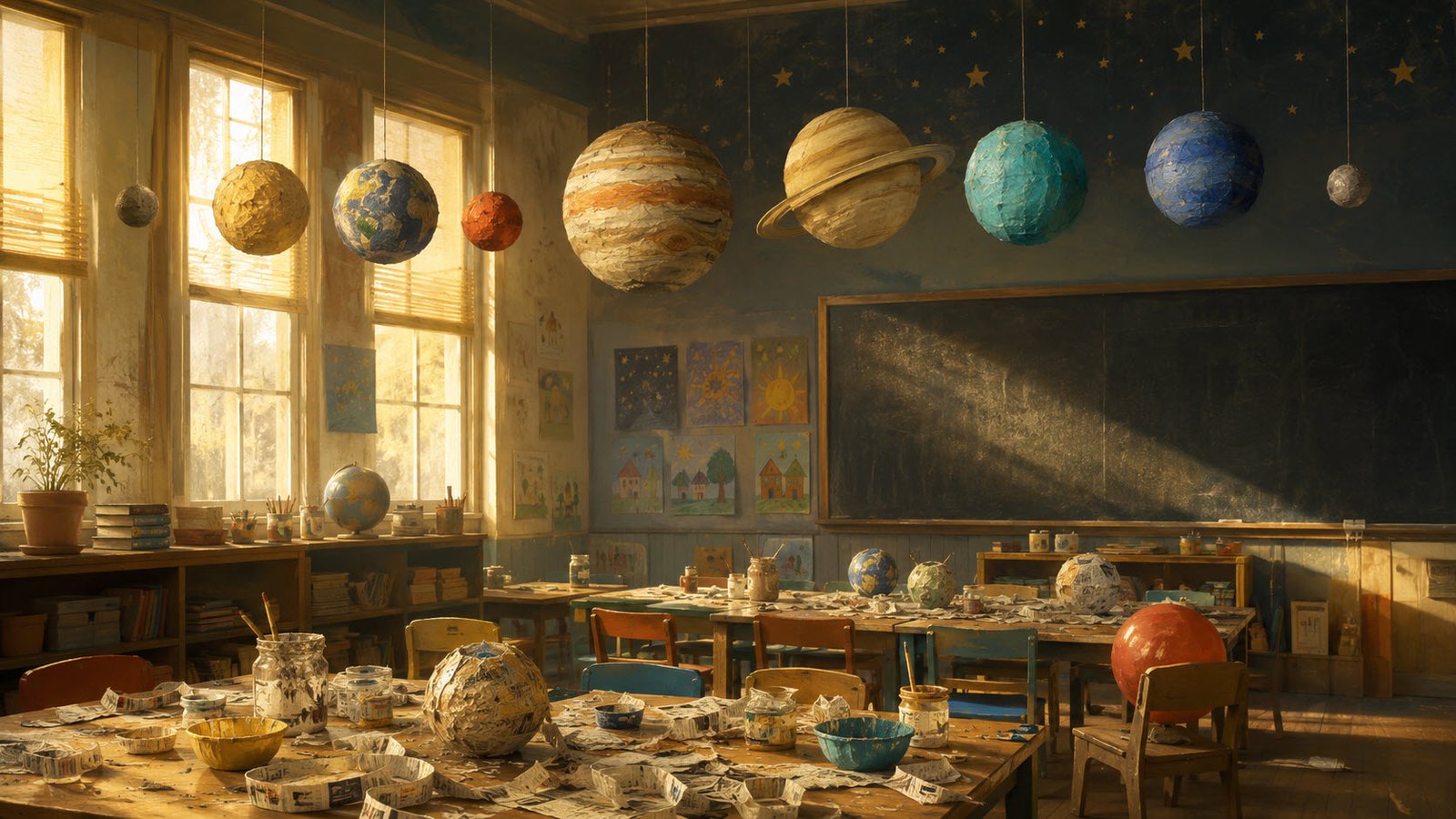
First, we made the spheres. We took strips of newspaper, soaked them in paste, and carefully applied them to balloons to create papier-mâché planets. As a child, I notoriously hated getting my hands dirty, but this time I was eager to put my bare fingers to work, smoothing the paste-soaked paper over the inflated rubber surface. The planets were worth the mess.
After they dried, we painted them. We learned just enough planetary science to understand what they looked like physically and to make our balloon-shaped worlds resemble them as best we could. I remember enjoying painting Uranus a bright turquoise, which was then my favorite color.
Finally, my teacher hung the completed planets from the classroom ceiling on fishing line. They remained there above us throughout the school year. Celestial bodies overhead.
I was so enthralled by that classroom solar system that I decided I needed one of my own. My father had given me a wire-bound sketchbook filled with good quality art paper. Over several days, I filled it page by page with drawings of the planets as I then understood them: Mercury, Venus, Earth, Mars, Jupiter, Saturn, Uranus, Neptune, and Pluto, all in their proper sequence from the Sun.
Dad was impressed. He brought home sheets and sheets of black poster board from work so the drawings could be mounted together. He stapled the boards into one long strip. I cut out the planets by hand with child scissors, and then Dad and I glued them down in their correct order.
When the work was complete, he mounted the whole solar system near the ceiling on the living room wall, above the back door and window. From the sofa, I could look up and see my masterpiece: the planets suspended in order against a field of black.
One night, my brother and I were being babysat while my parents were out at some social event. Our babysitter was one of Dad’s students. Sitting on that same living-room sofa, I demonstrated my knowledge of the planetary sequence by reciting their names in order.
At first, she assumed I knew the order because I could simply look up and see them. So she covered my eyes with her hands and asked me to do it again.
Mercury, Venus, Earth, Mars, Jupiter, Saturn, Uranus, Neptune, Pluto.
I knew them by heart.
Sometime later, I saw a television documentary about the planets, presented as a night with an astronomer at an observatory. I marveled at the images of those planetary bodies, especially Jupiter with its great red eye. I felt some connection to it, and to all of them, that I did not yet understand.
I even dreamed one night of traveling through the solar system.
The planets were alive and well in my unconscious before I had any language for what that might mean.
I did not know then that the planets would become part of my vocation. I did not know that they would become symbols, companions, teachers, and signs within a larger language of meaning. I only knew that they belonged overhead, in order, shining in the mind.
The universe was larger, stranger, and more wonderful because they were there.
Continue exploring…
For more articles about astrology, faith, meaning, memoir, and the life we share beneath the sky, explore Reflections.