

Carl G. Jung: Giving Form to the Unseen
Carl Gustav Jung was a Swiss psychiatrist and the founder of analytical psychology. Jung’s symbolic imagination helped modern astrology speak about psyche, archetype, vocation, and the deep work of becoming whole.

CARL G. JUNG
Giving Form to the Unseen
Carl Gustav Jung was a Swiss psychiatrist, the founder of analytical psychology, and one of the great modern explorers of symbolic life. His work carried the study of the unconscious beyond the consulting room into dreams, religion, mythology, art, alchemy, fairy tales, visionary experience, and the deep structures of imagination. Ideas such as complexes, psychological types, archetypes, the collective unconscious, synchronicity, and individuation travelled far beyond the clinical encounters in which much of his thought began.
That breadth can make Jung seem more abstract than he really was.
His psychology did not begin as a museum of archetypes arranged under glass. It began in relationship: with patients, colleagues, family, dreams, fantasies, symptoms, conflicts, religious images, and those unsettling moments when a person discovers that the conscious mind is not master in its own house. The enormous body of work he left behind — the Collected Works, seminars, letters, memoir, notebooks, and the visionary labour eventually published as The Red Book — was not the product of casual speculation. It was the record of a lifetime spent trying to give language to what modern consciousness had learned to dismiss, fear, medicalize, or forget.
For astrologers, Jung’s importance is difficult to overstate. He did not merely comment on astrology from the outside. He used it, studied it, corresponded about it, and treated it as one of the symbolic languages through which psyche and world might be contemplated together. Even more importantly, his understanding of symbols, archetypes, projection, synchronicity, and individuation gave astrology a way of becoming psychologically serious without reducing itself to prediction or personality typing.
He helped create the atmosphere in which astrology could be psychologized deeply.
Not flattened into fortune-telling.
Not defended as crude mechanism.
Not reduced to superstition.
But received as a symbolic language through which the soul’s patterns, conflicts, images, and developmental invitations might be contemplated.
His nativity therefore invites a central question:
What kind of personal dynamic might enable someone to enter the imaginal depths, remain there long enough to learn their language, and then give durable form to what he encountered?
The horoscope cannot explain Jung, prove his theories, authenticate his visionary experiences, or account for the choices through which his character emerged. Its influence, in the sense used here, is indicative rather than directive — and certainly not physical. The chart offers a symbolic lens. We look through it to see whether it reveals something previously unseen about the life, while allowing the life itself to confirm, deepen, complicate, or refuse the interpretation.
The technical astrological architecture has been gathered at the end. Readers may pass over it without losing the human argument. It is included for those who wish to see how the interpretation was constructed.
A Sunset Birth, Used with Caution
Jung was born on 26 July 1875 in Kesswil, Switzerland. The supplied time of 7:24 p.m. Bern mean time came through his daughter, Gret Baumann, and carries a Rodden rating of C rather than the stronger documentary ratings associated with a birth certificate or contemporary record.
The time nevertheless agrees with the family understanding that Jung was born as the Sun was setting. This makes the broad structure of the chart plausible, especially the Sun’s close relationship with the western horizon. The houses may be used, but not complacently. Fine conclusions depending upon an exact cusp should remain provisional.
This is not a chart to handle with false precision. It is reliable enough to offer a symbolic portrait, provided we remember that the portrait has softer edges than Romero’s.
A Structure Built at the Edge of the Unknown
Jung’s nativity suggests a person who needed strong boundaries precisely because he was unusually exposed to what lay beyond them.
He appears to have met life with seriousness, restraint, intellectual independence, and a powerful need to create order. He could stand apart, observe, classify, and resist being absorbed into the assumptions of the group around him. Yet this was not the comfortable detachment of someone untouched by what he studied. Hidden material pressed close. Psychological suffering, solitude, disturbing images, institutional life, spiritual questions, ancestral memory, and realities excluded from ordinary conversation seem to have belonged near the threshold of his identity.
The unknown was not simply an academic subject. It repeatedly arrived as a personal demand.
This helps explain one of the great tensions running through Jung’s life and work. He needed a strong conscious structure. Without one, the imaginal world might become overwhelming. Yet any structure strong enough to protect him could also become too rigid, too defended, or too certain of its own authority.
The task was not to choose between structure and depth. It was to build a form capable of meeting depth without denying it — and without surrendering entirely to it.
That distinction lies near the centre of analytical psychology. Jung did not propose that consciousness should dissolve into the unconscious. Nor did he believe the unconscious should be explained away as meaningless noise. The work was relational. Consciousness needed to become strong enough to encounter what it had excluded, receive what it did not understand, and remain present while its assumptions were altered.
The Image Wants to Be Heard
Jung’s chart suggests an unusually receptive imagination. Experience may have reached him first through images, moods, bodily impressions, emotional atmospheres, memories, repetitions, and symbolic associations before it could be organized into theory.
That matters because Jung is sometimes misremembered as merely a grand system-builder. The system came later. First came attention.
His early work at the Burghölzli psychiatric hospital included word-association experiments in which a patient’s delayed, confused, or emotionally charged responses were treated as meaningful. The hesitation was not merely a mistake. The irregular word could reveal that something beyond conscious intention had entered the exchange. Language was not transparent. Something hidden left tracks in speech.
That observation reflects one of Jung’s enduring gifts: he could attend to what seemed incidental, awkward, disproportionate, or strange and ask whether it belonged to a larger pattern of meaning. A dream image, verbal slip, fantasy, symptom, recurring story, religious motif, or astrological correspondence might carry more than the conscious mind intended.
But receptivity alone would not have been enough. Many people receive powerful images without finding a form through which they can be understood or shared. Jung’s particular strength lay in the effort to give those images language while preserving something of their living ambiguity. He did not want merely to explain them away. He wanted to enter into conversation with them.
This is one reason astrologers found him so valuable. Jung gave dignity to the image. He treated symbol not as decoration, error, or primitive confusion, but as a real mode of psychic knowing. A symbol, for Jung, is not merely a sign standing in for something already known. It is an image that opens toward meanings consciousness has not yet exhausted.
That insight gave modern astrology room to breathe.
The Earthy Work of Relationship
Jung is sometimes presented as though his psychology concerned archetypes floating somewhere above ordinary life. His actual work was far earthier.
It unfolded through encounters between people: patient and analyst, husband and wife, teacher and student, colleague and rival, conscious identity and the qualities projected onto another person. The nativity suggests that relationship was not secondary to Jung’s development. It was one of the principal fields through which he discovered both his authority and its limits.
Other people became mirrors, challengers, carriers of projection, sources of recognition, and sometimes embodiments of meanings far larger than any individual could reasonably bear.
This is especially visible in Jung’s relationship with Sigmund Freud. Freud was not merely a colleague. He became mentor, intellectual father, ally, and representative of a movement that appeared capable of transforming the understanding of the mind. Their association helped establish Jung internationally, but their differences over libido, religion, symbolism, and the nature of the unconscious steadily deepened. Their separation in 1913 was both an intellectual rupture and a profound personal crisis.
The horoscope did not require Jung to meet Freud or to break with him. It suggests a life in which encounters with powerful others would repeatedly force a difficult question:
Who possesses the authority to interpret experience?
At first, authority may be located in the admired teacher, institution, lover, rival, or projected figure. Development requires that some of what has been placed upon the other be recognized, reclaimed, and brought into conscious relationship. This is not achieved by declaring independence and walking away untouched. The relationship changes the person.
Jung’s later thought about projection grew from precisely this difficult territory. What fascinates or enrages us in another person may sometimes reveal something about ourselves that has not yet found a conscious place. The other is not merely an obstacle to self-knowledge. The other is often where self-knowledge begins.
Encountering Numinosity
but not Becoming It
Jung was strongly drawn to experiences that felt larger than the ordinary conscious personality: dreams, visions, religious images, archetypal patterns, synchronicities, and encounters with the numinous. His nativity suggests both a profound susceptibility to such experience and a lifelong effort to determine the proper relationship to it.
The danger was not simply credulity. It was inflation.
A person may encounter an image of immense power and unconsciously identify with it. Because one has experienced something archetypal, one may begin to imagine oneself uniquely chosen, prophetic, or entitled to speak with the authority of the image itself. Jung understood this danger because it belonged close to his own work.
The conscious personality needed to meet the numinous without imagining that it had become the source of the numinous.
At its best, this tension produces reverence: the recognition that psyche contains realities larger than the ego’s current understanding. At its worst, it can blur the difference between insight and projection, discovery and self-magnification. Jung’s work repeatedly warns that the ego is not the whole psyche. Yet any person who constructs a comprehensive symbolic system remains vulnerable to treating personal experience as universal law.
This tension should not be edited from the story. It is part of the psychological task his life attempted to address.
When the Inner World Broke Open
After the break with Freud, Jung entered the period he later called his confrontation with the unconscious. Beginning in 1913, he recorded visions, fantasies, dialogues, and active imaginations in notebooks that eventually became the basis of The Red Book. He painted images, developed elaborate calligraphy, and entered into sustained engagement with figures arising from the imaginal world.
The chart cannot explain why this occurred or certify the truth of what he encountered. It does, however, offer a symbolic picture of someone whose carefully constructed identity was repeatedly pressed by powerful material seeking recognition.
The decisive feature is not that Jung had visions. It is what he did with them.
He wrote them down. He painted them. He revisited them. He compared them. He attempted to distinguish their psychological meaning from their immediate emotional force. He built containers.
Another response might have been denial, disintegration, spiritual inflation, rigid intellectualization, or private absorption in an imaginal world never made useful to anyone else. Jung’s response was laborious. He tried to preserve the immediacy of the experience while gradually developing historical, mythological, religious, and psychological forms capable of carrying it.
This was not the conquest of the unconscious. It was an attempt to establish relationship with it. The work remained unfinished because such a relationship is never finally completed.
The Analyst as Translator
Jung’s gift was not simply to receive images. It was to translate among different kinds of reality.
He moved between symptom and symbol, personal history and myth, bodily experience and religious imagination, clinical observation and cultural tradition. This ability could make his writing extraordinarily generative. A dream reported by one person might be placed in conversation with an alchemical image, a biblical story, a folktale, a mandala, a planetary configuration, or a motif from another culture. The broad comparison could reveal dimensions the individual had not yet seen.
This is where his influence on astrology becomes especially important. Jung helped astrologers imagine a chart not merely as a list of traits or events, but as a symbolic field in which personal life and archetypal pattern meet. His language gave astrology a way to speak about projection, shadow, anima and animus, vocation, conflict, compensation, psychic development, and the gradual emergence of a more integrated centre.
Psychological astrology after Jung could ask richer questions.
Not simply, “What will happen?”
Not merely, “What type of person is this?”
But: What image is trying to become conscious? What has been projected onto the partner, parent, enemy, teacher, or beloved? Where has the personality overidentified with one part of itself and banished another? What kind of wholeness is being asked for here?
That is a profound inheritance.
It also carries responsibility. A large symbolic interpretation may become so compelling that the actual person disappears beneath it. The analyst may see the archetype but miss the patient. The astrologer may see Pluto, Saturn, Venus, or Neptune and forget the living person sitting across the table.
Jung’s finest work resisted this by returning repeatedly to the living individual. Individuation was not achieved by collecting impressive symbols or learning the terminology of analytical psychology. It required the difficult work of relating to oneself and to others more truthfully.
That work was clinical, moral, emotional, and embodied. It involved becoming conscious of projection, tolerating conflict, accepting limitation, recognizing the shadow of one’s preferred identity, and making choices in actual life.
Purely intellectual absorption in Jungian theory can therefore become a dry dead end. One may know every archetype and remain unable to apologize. One may discuss the shadow and continue projecting it upon everyone nearby. One may praise the union of opposites while refusing the person across the table.
Jung’s psychology is alive only when the symbol returns us to relationship.
The Shadow of the Structure
Jung’s nativity suggests a formidable capacity to construct intellectual and psychological order. It also suggests that whatever was excluded from that order would return with considerable force.
This resembles his later understanding of the shadow, though no planet simply “is” the shadow and no chart placement can be equated mechanically with a psychological concept. The shadow consists partly of qualities the conscious personality has refused, condemned, neglected, or failed to recognize as its own. The more definite the conscious identity becomes, the more distinct its unacknowledged opposite may appear.
For Jung, the task was not to destroy the conscious structure. A weak or diffuse ego cannot engage the unconscious very effectively. It is more likely to be overwhelmed by it. The task was to make consciousness strong enough to encounter what it excluded without immediately projecting it elsewhere.
That is more difficult than the popular language of “embracing your shadow” often implies. The shadow may contain vitality and creativity, but also selfishness, aggression, envy, cowardice, prejudice, and the capacity to harm. Integration does not mean approving everything discovered within oneself. It means becoming responsible for the fact that it is there.
Jung’s own life and work should be read by the same standard. His cultural assumptions, personal blind spots, authoritarian tendencies, and moments of inflation cannot simply be ignored because he taught others to examine their shadows. A psychology of the shadow must also be applied to its founder.
But this is not a dismissal of Jung. It is a Jungian way of taking him seriously. A thinker of his magnitude does not become less important when read critically. He becomes more real.
The Centre Is Discovered Through the Other
Jung’s work on individuation is sometimes misunderstood as a spiritualized form of individualism: the heroic person withdrawing from society to become uniquely themselves. His nativity suggests something more relational.
The development of a coherent centre appears repeatedly tied to encounter, projection, conflict, and dialogue. The self is not discovered by sealing oneself away from other people. It is discovered partly through noticing what happens in their presence.
Whom do we idealize? Whom do we despise? Whose approval seems necessary? Who appears to carry the confidence, tenderness, authority, sensuality, intelligence, or freedom we cannot yet recognize in ourselves?
Relationships reveal the unfinished business of identity.
This does not mean that every judgment about another person is merely projection. Other people possess realities of their own. The difficult work lies in distinguishing what belongs to them from what we have placed upon them.
Jung’s solar development appears to have unfolded within precisely this field. Authority was discovered through collaboration and rivalry. Independence grew through the painful differentiation from an intellectual father. Ideas became clearer when challenged by patients, colleagues, critics, and intimate relationships.
The centre was not given once and for all. It had to be found repeatedly in the space between self and other.
The Feminine Mediator
Jung’s historically gendered language included the concept of the anima, the interior feminine figure that mediates between a man’s conscious identity and the unconscious. The language requires careful handling today. It carries assumptions about sex and gender that should not be imported uncritically into contemporary psychological work.
Yet the underlying insight remains valuable: aspects of psychic life that the conscious personality does not identify as its own may first appear through attraction, fantasy, dream, mood, image, or projection onto another person.
Jung’s nativity gives unusual prominence to a receptive, relational, and image-bearing current. Experience appears capable of moving from bodily feeling and emotional atmosphere toward language and form. Images are not simply decorations. They mediate between conscious thought and realities that cannot yet be approached directly.
One might describe the process this way:
The psyche presents an image.
Feeling gives it weight.
Relationship gives it context.
Language allows it to become thinkable.
Work gives it a form that can be revisited.
This is not a theory arriving fully formed from above. It is meaning woven gradually from experience. Jung’s psychology repeatedly returned to this mediating function. The image allows conscious and unconscious life to meet without either being reduced entirely to the other.
The Search for a Third Thing
Jung was fascinated by opposites: consciousness and unconsciousness, masculine and feminine, spirit and matter, individuality and collectivity, good and evil, reason and instinct. He did not believe that psychological development consisted simply of choosing the correct pole.
The conflict had to be endured long enough for a new possibility to emerge.
This is the deeper meaning of the coniunctio, the symbolic union of opposites. It is not a bland compromise in which all differences disappear. Nor is it a victory of one side over another. It is the appearance of a third thing that could not have existed before the conflict was consciously held.
Jung’s nativity suggests a strong inclination to seek coherence within difficult, shared, and emotionally charged material. He could move beyond the immediate quarrel and ask what larger pattern it expressed. That capacity helped him build a psychology broad enough to engage religion, myth, culture, symbolism, and the hidden architecture of experience.
It could also become too comprehensive. The desire to find a meaningful pattern everywhere may cause genuine differences to be smoothed over or particular histories to be absorbed into an elegant universal scheme. The third thing must emerge from the actual tension. It cannot be imposed merely because the interpreter prefers synthesis.
From Movement to Independent Ground
Jung’s early professional identity developed within institutions and relationships: the Burghölzli, his patients, Freud’s movement, inherited psychiatric models, religious tradition, and philosophical thought. His life then required a repeated movement toward independent judgment.
The separation from Freud was the most dramatic expression, but the pattern is larger. Jung had to determine which ideas he had received could honestly become his own, which needed revision, and which had to be refused.
Individuation in this sense is not originality for its own sake. It is responsibility for one’s standpoint.
A person begins embedded in collective assumptions, family loyalties, intellectual traditions, cultural prejudices, and projections. Development requires some differentiation from these conditions. But differentiation is not sterile isolation. The aim is to become sufficiently distinct that one can enter conscious relationship with the collective rather than remaining unconsciously absorbed within it.
Jung’s work continually moved between these poles: immersion in shared psychic material and the establishment of an individual ground from which he could respond to it.
Building a School Without Freezing the Work
Jung’s vocation did not remain confined to private reflection or the consulting room. He gathered students, taught, lectured, corresponded widely, and participated in the creation of institutions through which analytical psychology could continue. The C.G. Jung Institute Zürich was founded in 1948 with his involvement.
The nativity suggests a public calling carried into groups, movements, intellectual communities, and institutions organized around a shared vision. This gave the work continuity. It also created a familiar danger: a psychology concerned with living symbols could harden into a school with correct terminology, approved interpretations, and reverence for its founder.
Any tradition must develop form if it is to survive. But form can become a substitute for the experience it was meant to serve. The institution may begin protecting Jungian theory rather than supporting the psychological work that gave rise to it.
That is why analytical psychology remains most alive in the consulting relationship, where theory must meet an actual person who will inevitably fail to fit it neatly. The symbol is useful only while it helps restore contact with life.
A Psychology That Resembles Its Maker
There is a striking correspondence between Jung’s nativity and the psychology he developed. The chart does not predict analytical psychology, but the recurring tensions in the life resemble the questions his psychology repeatedly asked.
How can conscious identity encounter what it has excluded?
How does a person reclaim what has been projected onto another?
How may powerful images be received without being mistaken for literal commands?
How can opposites remain in relationship without one destroying the other?
How can immersion in collective material lead toward a more differentiated life?
How does a person build a strong centre without imagining that the centre is the whole?
Jung did not merely invent these problems as intellectual topics. He lived inside them. His psychology can be understood, in part, as the conceptual form given to tensions he encountered clinically, relationally, culturally, and within himself.
At its best, this gives his work depth and authority. He wrote about psychic realities that had cost him something. His psychology sometimes seems like the chart reflecting upon its own difficulties: structure confronting what structure excludes, consciousness meeting the image, identity being disrupted by the other, and the individual struggling to differentiate from the collective without losing relationship to it.
Jung did not merely describe individuation. He spent his life engaging it.
Authority and Its Limits
Jung possessed unusual powers of synthesis. He could bring distant materials into conversation and construct a symbolic framework capacious enough to hold experiences modern psychology often dismissed. The scale of his work still astonishes: clinical psychology, mythology, religion, alchemy, philosophy, art, dreams, typology, synchronicity, and the symbolic life all entered the field of his attention.
That immensity matters.
It is one reason astrologers continue to return to him. Jung gave astrology something more valuable than approval. He gave it a psychological depth language. He helped make it possible to speak of planetary symbols as archetypal patterns, of chart interpretation as a dialogue with the psyche, of synchronicity as a meaningful coincidence rather than a mechanical force, and of astrological insight as part of the larger work of individuation.
His strengths nevertheless carried corresponding shadows. Structure could become rigidity. Symbolic insight could become inflation. Broad comparison could become overgeneralization. Personal experience could be presented too quickly as universal pattern. The theory could become more visible than the person it was meant to serve.
These limitations are not reasons to dismiss Jung. They are reasons to read him in the spirit of his own best method: appreciatively, critically, relationally, and with attention to the shadow cast by every strength.
A living Jungian practice does not require agreement with Jung at every point. It requires the willingness to test whether an idea deepens relationship to experience.
What the Chart Did Not Decide
The nativity did not cause Jung to found analytical psychology. It did not make his theories true, his errors inevitable, his relationships necessary, or his visionary experiences divinely authorized. It does not prove that archetypes exist as Jung described them. It does not confer privileged access to universal truth.
The chart offers a symbolic field through which certain recurring themes may become more visible: strong conscious structure, proximity to excluded material, imaginal receptivity, relationship as a field of development, the pressure of projection, the search for meaning within opposites, and the need to establish an independent standpoint without severing connection to the collective.
Other lives could have arisen from the same symbolic roots. The chart might have accompanied an institutional theorist who never risked the imaginal world, a visionary who never developed a disciplined language, or a system-builder unable to tolerate contradiction. Jung became none of these exclusively, though traces of each possibility remained.
Character emerged through the way he repeatedly answered the conditions of his life: through observation, writing, analysis, relationship, conceptual labour, institutional creation, and sustained engagement with images he could neither dismiss nor fully explain.
The Shape of the Call
Jung’s nativity offers the image of a person called to establish form at the threshold of what ordinary consciousness excludes.
The life begins with the need for structure: a strong enough vessel to approach psychological depths without being overwhelmed by them. It develops through receptivity to images, symptoms, moods, memories, and patterns that demand language. It moves into relationship, where authority is projected, challenged, reclaimed, and repeatedly redefined. It enters the imaginal world but must learn not to confuse encounter with possession. It builds concepts, books, seminars, schools, and institutions while remaining vulnerable to the danger that living experience may harden into system.
None of this required the life Jung lived. The same symbolic conditions might have accompanied withdrawal, dogmatism, private fantasy, or intellectual grandeur without genuine relationship.
Jung’s life gave them another historical form.
Disturbance became observation.
Image became dialogue.
Crisis became sustained psychological work.
The other became a threshold to the unknown self.
The unseen was not conquered, but given forms through which conscious life might approach it.
The chart offers the shape of a call; the life reveals the answer.
Jung’s answer was to enter the depths and return carrying a language — primal, debatable, luminous, unfinished — through which others might begin the earthy work of relating more truthfully to themselves, to one another, and to the living symbols that move beneath the surface of ordinary life.
Under the Hood: The Astrological Architecture
The following notes show how the interpretation was constructed. They are not additional meanings readers must master. They are the principal testimonies from which the synthesis was inferred.
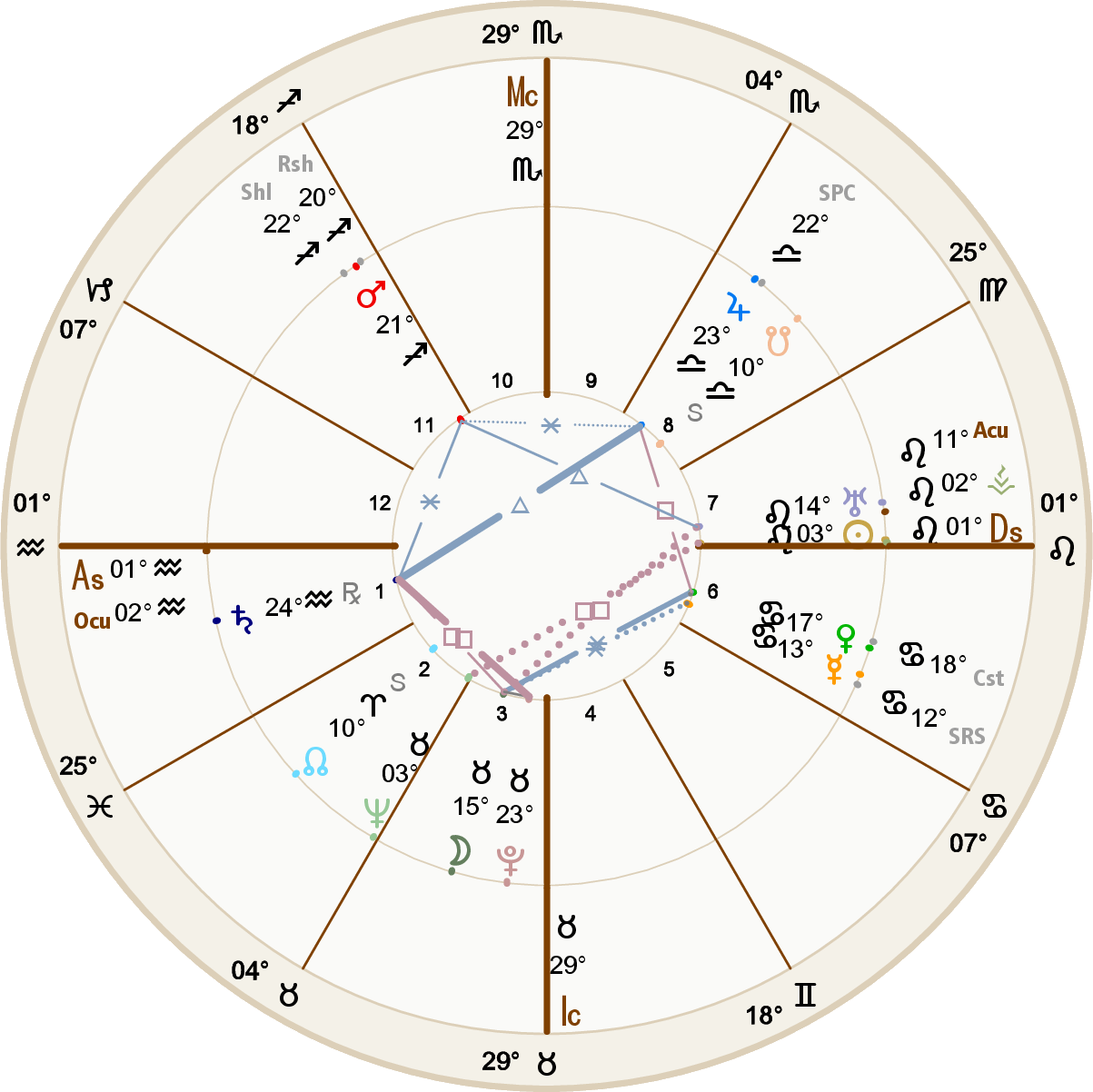
Legend
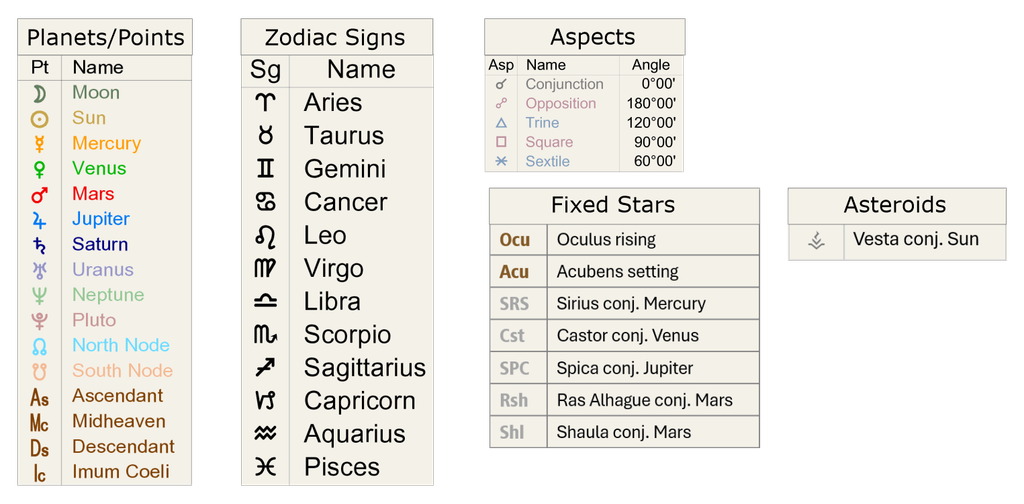
Birth Chart
The Nativity of Carl G. Jung
- Date
- Time
- Place
- Kesswil, Switzerland
A note on rulers and Almutens
The ruler of a house is its ordinary governor by sign: the planet responsible for conducting its affairs.
The almuten is the planet with the strongest essential claim at the exact degree of the house cusp.
The ruler may be imagined as the working steward. The almuten is the senior authority whose credentials give it the strongest claim. When the same planet fills both roles, its authority is concentrated.
The person at the threshold
- Aquarius rises.
- Saturn is both ruler and almuten of the First House.
- Saturn is in Aquarius in the First.
- Saturn also rules and is almuten of the Twelfth House.
- Saturn squares Pluto in Taurus in the Third.
These testimonies underlie the interpretation of strong conscious structure, intellectual independence, proximity to excluded or hidden material, and sustained pressure from disturbing thoughts, images, memories, and perceptions.
The square does not cause psychological crisis. It suggests a recurring negotiation between form and what resists being contained by form.
The receptive and image-bearing mind
- The Moon is exalted in Taurus in the Third House, the house of its traditional joy.
- The Moon sextiles Mercury and Venus in Cancer.
- The Moon and Venus are in mutual reception.
- The Moon rules the Sixth House.
- Venus rules the Third and Fourth and is almuten of the Second and Sixth.
These factors support the interpretation of experience received through image, bodily feeling, memory, emotional atmosphere, observation, and repetition.
They also connect clinical work and service with language, interpretation, and the shaping of living experience into communicable form.
Work as translation
- Mercury and Venus are conjunct in Cancer in the Sixth House.
- Mercury rules and is almuten of the Fifth and Eighth Houses.
- Mercury is conjunct Sirius.
- Venus is conjunct Castor.
- Both Mercury and Venus have some essential resources but limited accidental strength.
Mercury carries creative, imaginal, hidden, and psychologically charged material into work and service.
Venus adds relationship, proportion, analogy, tact, and aesthetic form.
Their lower accidental strength suggests that this influence develops through persistent labour rather than direct public authority: cases, correspondence, interpretation, revision, and writing.
The fixed stars may intensify magnitude and tonal complexity. They do not confer truth or genius.
Identity through encounter
- The Sun is in Leo in the Seventh House, closely conjunct the Descendant.
- The Sun rules and is almuten of the Seventh.
- The Sun is strongly dignified and supported by sect.
- Vesta is conjunct the Sun.
- Uranus is in the Seventh.
- The Moon squares Uranus.
These testimonies underlie the interpretation of relationship as a principal field of identity, authority, projection, disruption, and development.
The other becomes catalyst: patient, partner, collaborator, rival, teacher, or carrier of qualities not yet consciously recognized.
Vesta concentrates dedication within this relational field.
Authority, vision, and inflation
- The Sun forms a partile square to Neptune in Taurus.
- Neptune is in the Second House but close to the Third-house cusp.
The square suggests recurring tension among conscious authority, relationship, imagination, idealization, numinous experience, personal value, and interpretation.
It does not prove spiritual insight or deception.
It supports the reflection upon inflation: the danger that the conscious personality may identify with the magnitude of an archetypal or numinous experience.
Vocation entering schools and movements
- Scorpio is on the Midheaven.
- Mars is both ruler and almuten of the Midheaven.
- Mars is in Sagittarius in the Eleventh House.
- Mars also carries the Ninth House into the Eleventh.
- Mars sextiles Jupiter and Saturn.
- Jupiter trines Saturn.
- Mars has modest essential resources but useful accidental strength.
- Its sect condition is mixed.
These factors support the interpretation of vocation operating through philosophy, religion, teaching, public responsibility, intellectual movements, groups, institutions, and the establishment of an independent school.
The mixed condition of Mars suggests that public action may be consequential without being entirely comfortable or free from conflict.
Shared psychic material and independent value
- Jupiter is in Libra in the Eighth House.
- Jupiter rules the Second and Eleventh Houses and is almuten of the Eleventh.
- Jupiter has moderate essential dignity but limited accidental strength.
- Jupiter is in hayz, although occidental.
- The South Node is in Libra in the Eighth.
- The North Node is in Aries in the Second.
The Eighth-house emphasis supports the interpretation of work with material larger than the isolated ego: shared psychic systems, intimate entanglement, inheritance, mortality, dependence, and what belongs partly to others.
The nodal axis describes a recurring polarity between immersion in collective or relational material and the establishment of an independent ground of value, judgment, and responsibility.
It is not a compulsory ladder from bad to good.
The chart’s central relationships
The broad architecture may be summarized as several cooperating and conflicting movements:
- Saturn seeks form, distinction, and containment.
- Pluto presses buried or disturbing material toward consciousness.
- The Moon receives images and emotional atmospheres.
- Mercury and Venus translate them through language, relationship, and work.
- The Sun develops authority through encounter.
- Neptune complicates the boundary between insight and projection.
- Jupiter seeks meaning within shared depths and opposing principles.
- Mars carries the vocation into communities, movements, and institutions.
- The nodal axis asks that immersion in collective material become a consciously differentiated life.
Continue exploring…
For more articles about astrology, faith, meaning, memoir, and the life we share beneath the sky, explore Reflections.