

Prime Minister Mark Carney: The Northern Champion
Mark Carney’s horoscope reveals a striking pattern of strategic effectiveness: building alliances, redesigning systems, and acting where leverage matters. In a changing Canada, the symbolism of Perseus and Capulus offers an unusually vivid lens on leadership.

PRIME MINISTER MARK CARNEY
The Northern Champion
Nativities are symbolic portraits of the conditions, tensions, capacities, and fields of life through which people are called to become themselves. Each post has two parts: first, an accessible reflection on the life and its recurring patterns; then, Under the Hood, a technical account of the astrological architecture behind the interpretation. A nativity does not dictate a life; it offers a perspective from which to illuminate and contemplate how that life is being lived.
With a living political figure, that distinction matters especially. A horoscope cannot tell us whether a government is right, whether a policy will succeed, or how anyone should vote. It does not confer virtue, wisdom or competence.
Politics remains the proper territory of evidence, judgment, debate, democratic choice and consequence.
What astrology can sometimes do is reveal the symbolic coherence of a life.
Mark Carney’s nativity poses an unusually clear question:
What happens when a person possesses a deep faith that intelligent action can make apparently immovable circumstances move?
The technical astrological architecture has been gathered at the end. Readers may pass over it without losing the human argument. It is included for those who wish to see how the interpretation was constructed.
Something Has Changed in the Language of Canada
Sovereignty. Strategic autonomy. Resilience. Nation-building. Diversification. Building at home. New partnerships abroad.
These words now recur throughout the language of Carney’s government. Together they describe a Canada confronting an uncomfortable reality: assumptions that once governed its relationship with the United States can no longer simply be taken for granted.
Carney has described the changing international order as a rupture. His response has not been to imagine that Canada can become another great power. Instead, he argues that Canada must become more capable of acting for itself — strengthening its resources at home while multiplying its relationships abroad.
At the Lowy Institute in Sydney, he described a “dense web of connections”: coalitions assembled issue by issue among countries with enough common ground to act together. Great powers possess the scale and leverage to act alone, he argued. Middle powers generally do not. When they negotiate separately with a hegemon, their weakness is magnified; when they combine their capacities, another possibility appears.
This is more than a foreign-policy programme. It reveals a recurring style of response.
A problem appears. What resources are available? Which relationships can be mobilized? Where is the leverage? What part of the existing machinery no longer works? What configuration might work instead?
The governing assumption is that circumstances are not merely to be endured.
They can be acted upon.
Sovereignty as Capacity
Carney’s language of sovereignty is strikingly material.
Independence is not merely a declaration, a sentiment or a flag. It depends upon what a country can actually do.
Can it feed itself? Fuel itself? Defend itself? Build infrastructure? Reach more than one market? Secure critical resources? Develop technologies it cannot safely entrust entirely to somebody else?
In Sydney, Carney argued that Canada’s strategic imperative is to develop “sovereign capabilities and resilient options” at home and with trusted partners, so that integration does not become subordination.
This is an earthy understanding of freedom.
Freedom requires resources.
That does not imply autarky. In fact, Carney’s strategy assumes precisely the opposite. A middle power cannot manufacture complete independence by withdrawing from relationship. Its freedom depends partly upon having enough relationships that no single relationship becomes absolute.
Sovereignty therefore becomes a balance between capacity and connection.
Canada must possess enough of its own material strength to retain meaningful choices, while constructing enough alternatives abroad that dependence on one partner does not become destiny.
Relationship as Infrastructure
This is where Carney’s extraordinary investment in relationship becomes important.
His international address book has often been treated as a biographical asset: a former central banker and international financial figure happens to know a great many influential people.
But under his government, relationship itself has become a strategic instrument.
Canada has pursued new arrangements in defence, trade, critical minerals, energy, artificial intelligence and investment. Carney has repeatedly advocated coalitions that do not require universal agreement. Countries can work together where their interests overlap without pretending that they form one seamless political bloc.
He calls this “variable geometry.”
The phrase is unusually revealing.
The geometry changes with the problem.
One set of countries may cooperate on critical minerals, another on defence, another on artificial intelligence, another on trade. The important question is not whether everyone belongs to the same permanent alliance. It is whether enough complementary interests can be assembled to produce an effect.
Relationship, in this formulation, becomes infrastructure.
Trust becomes a strategic asset. An alliance creates options. A network distributes risk. A web of connections allows a middle power to act with greater weight than its population or military strength alone might suggest.
Gulliver and the Threads
There is another image for what Carney is attempting.
Canada lives beside Gulliver.
The disparity in population, capital, military power and market size between Canada and the United States is enormous. A purely bilateral contest conducted entirely on American terms begins with an obvious asymmetry.
Carney’s answer is not to imagine Canada can somehow become another giant.
It is to weave threads.
Trade relationships. Defence arrangements. Alternative export markets. Critical-mineral partnerships. Research agreements. Supply chains. Sources of investment.
No individual thread restrains Gulliver.
The network can.
Carney has argued that middle powers negotiating separately with a hegemon are easily divided and pressured. Working together, they can create what he calls a “third path with impact.”
This is not multilateralism as good manners.
It is relationship as power.
The point is not to defeat the giant at his own game. It is to create enough alternatives that the giant cannot determine every movement simply because he is larger.
The Instinct to Make Things Work
The same pattern appears domestically.
Carney’s political language is filled with bottlenecks, duplication, certainty, timelines, execution and results. Problems are often described not as permanent features of reality but as systems that have ceased producing what they were meant to produce.
That distinction matters.
It is one thing to say that Canada needs more infrastructure.
It is another to ask why Canada has become so bad at building it.
Bill C-39, the Building Canada Strong Act, is an unusually clear example. The government describes the legislation in terms of greater “speed, certainty, and predictability” in project reviews, with more coordinated decisions and a faster route through federal processes.
The legislation is politically contested. Faster processes raise legitimate questions about what may be lost in the acceleration: environmental scrutiny, Indigenous consultation, labour protections, community interests and democratic accountability.
Those debates cannot be decided astrologically.
But the form of the response is revealing.
If the machinery is preventing the desired result, examine the machinery.
If the process is duplicative, redesign it.
If uncertainty is preventing investment, move the decisive question earlier.
There is a powerful faith here in effectiveness: the assumption that intelligent intervention can change material circumstances.
“Canada Stopped Building Big”
Pacific Link makes that operating philosophy particularly visible.
On October 1, Carney announced that the proposed West Coast oil pipeline, now known as Pacific Link, would be listed as a project of national interest. The government presents it as part of a larger effort to diversify Canadian trade, reach Asian markets and reduce overwhelming dependence on the United States as the destination for Alberta oil.
Carney’s diagnosis of the previous system was characteristically blunt:
Canada had stopped building big.
Project proponents, he argued, could spend years and potentially billions of dollars without knowing whether the federal government would ultimately support what they were trying to build. His government’s answer is to make the national-interest decision earlier, organize consultation and regulation around that decision, reduce uncertainty and give proponents greater confidence to proceed.
Whether Pacific Link ultimately proves economically wise, environmentally sustainable or politically durable remains open to judgment.
But the form of the response is unmistakable.
Understand the obstacle. Change the process. Assemble the resources. Build.
The desired outcome is not theoretical.
Something exists that did not exist before.
The Sword Is Not a Club
Canada’s response to American tariffs offers another version of the same instinct.
The countermeasures introduced in September were targeted rather than indiscriminate. Canada matched American tariffs on $27.6 billion of goods, concentrating them in sectors including steel, dairy, appliances, agricultural equipment, pulp and paper, plastics and electronics.
The distinction between a targeted response and generalized retaliation is important.
A club is swung.
A sword is directed.
The strategic question is not merely whether to respond. It is where pressure can produce consequences.
Which industries matter? Where does Canada possess leverage? Which measures impose costs without doing unnecessary damage at home? How can an economic response become a negotiating instrument rather than simply an expression of anger?
Again, the governing instinct is not force for its own sake.
It is force made intelligent.
Imagining Another Arrangement
Yet Carney’s strategy cannot be understood simply as technocratic efficiency.
There is another quality present: the willingness to imagine arrangements that do not yet exist.
“Variable geometry” is a particularly good example. It assumes that inherited institutions and alliances need not determine every future configuration. Different combinations may be assembled around different problems.
This is more imaginative than bureaucratic.
Carney’s middle-power strategy asks whether a world increasingly organized around great-power rivalry might contain another possibility: not a single rival hegemonic bloc, but overlapping networks capable of giving smaller powers more room to manoeuvre.
The answer may or may not work.
That is precisely why it is interesting.
It attempts to create political space that does not yet fully exist.
The instinct is not merely: How do we make the old arrangement work better?
It is also:
What arrangement would work now?
Effectiveness and Its Limits
Here we reach the more difficult question.
What counts as effective?
A regulatory system may process decisions more quickly. A pipeline may create an additional export route. A tariff may create bargaining leverage. A new alliance may reduce dependence on an existing one.
All of those outcomes can be measured.
But public life contains goods that cannot be collapsed into efficiency alone.
Environmental stewardship matters. Indigenous rights matter. Labour rights matter. Democratic accountability matters. Distribution matters. The long-term consequences of decisions matter.
A technically workable solution is not necessarily the whole solution.
Efficiency is a good.
It is not the only good.
This may be the most important question raised by Carney’s style of leadership. A strong instinct for effectiveness can produce extraordinary practical capacity. It can also tempt a political culture to define problems primarily in terms most amenable to solution.
The deepest political judgment therefore lies not simply in asking whether something can be made to work, but in determining what the work is ultimately for.
The Northern Champion
The title of this nativity comes from Perseus, the great champion of the northern sky.
The mythology matters because Perseus does not defeat Medusa through superior brute strength.
He cannot.
The obvious approach would destroy him. Anyone who looks directly upon Medusa becomes stone.
Perseus must first understand the nature of the problem.
He receives instruments from the gods, but possessing them is not enough. Athena’s polished shield allows him to see without looking directly. He approaches indirectly. He chooses his moment.
Then he acts.
The story is therefore not simply about courage.
It is about intelligence becoming action.
That is what makes the myth so resonant with Carney’s emerging political style. Canada cannot simply overpower the forces confronting it. It cannot become the United States. It cannot wish economic dependence away.
It can identify where dependence lies.
It can develop alternatives.
It can cultivate partners.
It can redesign systems.
It can use leverage.
It can act intelligently upon circumstances that once appeared given.
The Northern Champion is therefore not a declaration that Carney is a hero.
It describes an archetypal problem.
A northern country finds itself beside a giant in a world whose old arrangements are breaking down. Its leader cannot make it a superpower.
He can attempt to make it more capable of acting.
What the Chart Did Not Decide
The nativity did not cause Carney to become Prime Minister. It did not determine the policies of his government, make his economic assumptions correct, guarantee the success of Pacific Link, or prove that his middle-power strategy will work.
Nor does the chart tell Canadians what they should think about any of those things.
Other lives could have arisen from the same symbolic roots.
A powerful capacity for relationship might have produced a diplomat rather than a political leader. An instinct for systems could have remained within banking, administration or business. Confidence in intelligent action might have been exercised entirely outside public life.
Carney’s biography, education, institutional experience, relationships, historical circumstances and choices supplied the concrete life.
The nativity offers a symbolic field through which recurring themes become more visible: material capacity, relationship as leverage, systems as things capable of redesign, imagination translated into strategy, and a deep expectation that circumstances can be altered through intelligent action.
The Shape of the Call
Carney’s nativity offers the image of a person called to make effectiveness consequential.
The life moves repeatedly toward institutions, networks, systems and material problems. Relationship becomes more than sociability; it becomes infrastructure. Intelligence becomes more than analysis; it seeks intervention. Imagination does not remain merely visionary; it asks what new arrangement could actually function.
The same dynamic now appears on a national scale.
Build capacity at home. Find partners abroad. Reduce dependence. Identify leverage. Redesign what no longer works. Choose the instrument carefully.
Then act.
For a middle power beside a giant, that becomes more than personal temperament.
It becomes a theory of sovereignty.
Under the Hood: The Astrological Architecture
The following notes show how the interpretation was constructed. They are not additional meanings readers must master. They are the principal testimonies from which the synthesis was inferred.
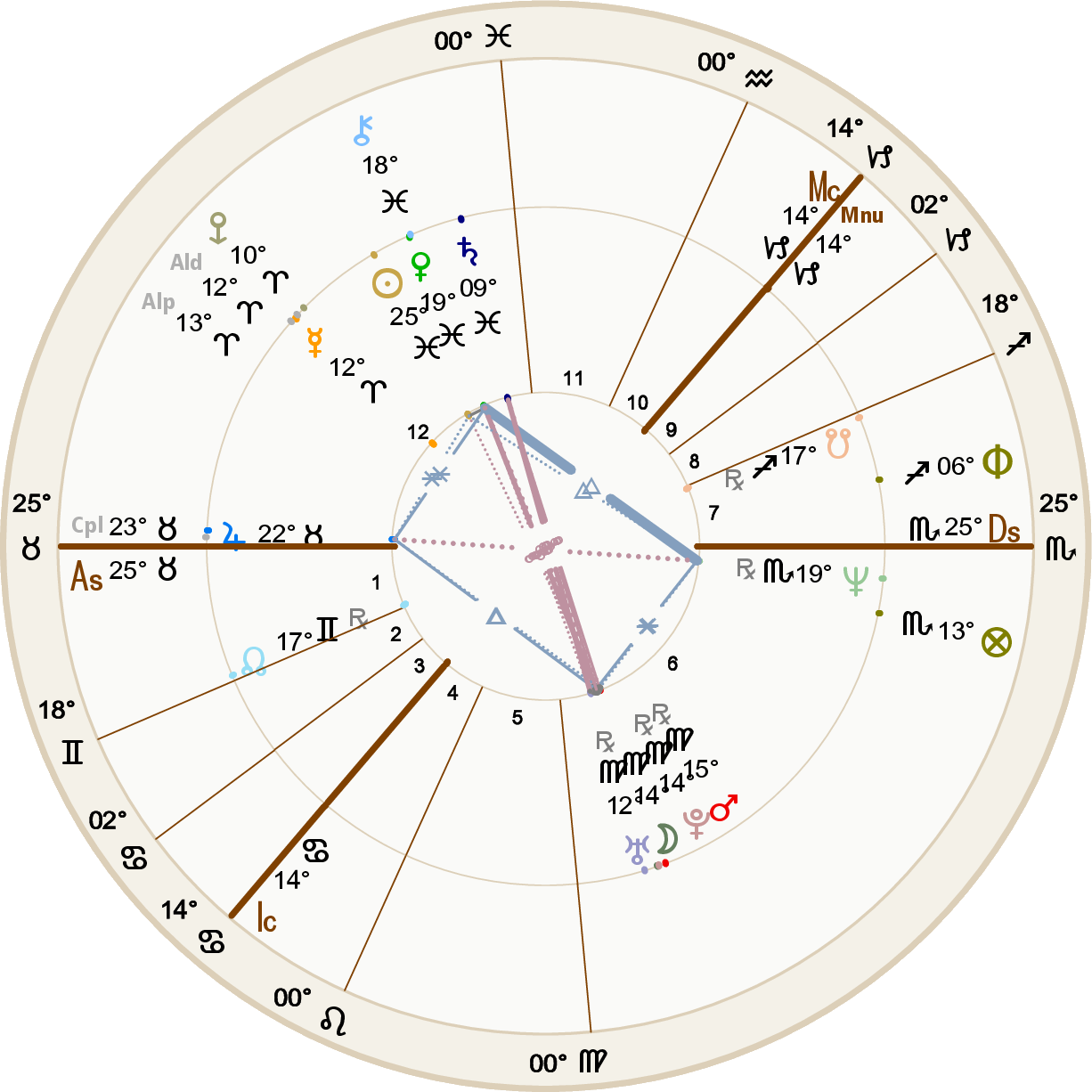
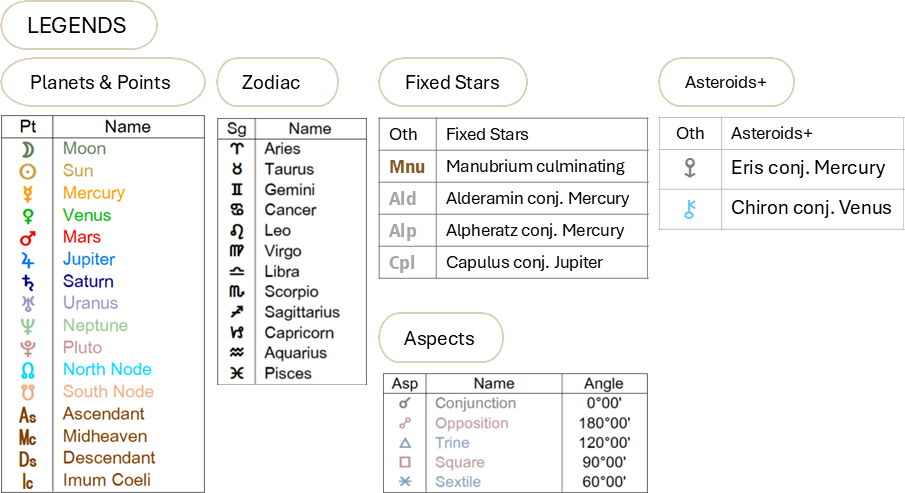
Birth Chart
The Nativity of Mark Carney
- Date
- Time
- Place
- Fort Smith, Canada
The recorded time gives us a chart reliable enough to use the angles and houses with reasonable confidence.
A Note on Rulers and Almutens
The ruler of a house is its ordinary governor by sign: the planet responsible for conducting its affairs.
The almuten is the planet with the strongest essential claim at the exact degree of the cusp.
The ruler may be imagined as the working steward; the almuten as the senior authority whose dignities give it the strongest claim. When the same planet fills both roles, its authority is concentrated.
Material Capacity as a Way of Meeting the World
- Taurus rises.
- Venus rules the Ascendant.
- Venus is also Almuten of the Ascendant.
- Jupiter is in Taurus in the 12th house, very close to the Ascendant.
These testimonies underlie the interpretation of material capacity, resources, sustainability and practical effectiveness as central to Carney’s way of meeting circumstances.
Jupiter’s proximity to the Ascendant is especially important. Although technically in the 12th house, it is brought strongly into manifestation through its closeness to the eastern horizon. Jupiter contributes confidence, judgment, breadth and faith; Taurus requires those qualities to find tangible expression.
Relationship as Structure
- Venus is exalted in Pisces.
- Venus is joined to Saturn.
- Venus governs and almutens the Ascendant.
- Venus also participates strongly in the Midheaven through dignity.
- Venus sextiles Jupiter.
- Venus trines Neptune in Scorpio.
These factors support the interpretation of relationship as more than personal sociability.
Venus joins, reconciles and creates connection. Saturn gives connection form, endurance, obligation and institutional durability. Jupiter broadens the usefulness of the network. Neptune enlarges the relational imagination beyond arrangements already in existence.
This is the astrological basis for the language of relational capital and for reading Carney’s coalition-building as relationship turned into infrastructure.
The Mechanic in the Engine Room
- Moon and Mars are conjunct in Virgo in the 6th house.
- Uranus and Pluto occupy the same Virgo concentration with varying orbs.
- The concentration stands opposite Venus in Pisces.
Moon-Mars in Virgo supports the interpretation of diagnosis, labour, technical intervention and the desire to correct what is not functioning.
Uranus and Pluto intensify the pattern. Uranus introduces discontinuity, innovation and systemic disruption; Pluto adds concentrated force, leverage and attention to underlying structures of power.
Together, the Virgo concentration suggests more than maintenance.
It can describe systemic redesign.
The opposition to Venus means that relationship, agreement and institutional continuity remain in tension with disruption, reform and practical intervention. Neither pole simply cancels the other.
Jupiter and Capulus
- Jupiter is in Taurus close to the Ascendant.
- Capulus is not itself rising.
- The projected ecliptic position of Capulus conjoins Jupiter.
- Capulus belongs to Perseus.
- Traditional fixed-star doctrine gives Capulus a Mercury-Mars nature.
The technical distinction is important. Jupiter is the planet physically brought to prominence at the Ascendant; Capulus modifies Jupiter through conjunction by projected position.
Mercury and Mars provide the star’s underlying quality.
Mercury discriminates, calculates and strategizes.
Mars acts.
Jupiter adds confidence, judgment and faith.
Taurus requires material consequence.
The Ascendant brings the combination into the person’s immediate way of engaging the world.
This is the basis for the central interpretation:
an intrinsic faith in effectiveness resulting from intelligent action.
The Earth Trine
- Moon-Mars in Virgo trines Jupiter in Taurus.
- Both ends of the relationship occupy earth signs.
This aspect connects practical intelligence directly with Jupiterian confidence.
Virgo identifies what is wrong and determines what must be done. Mars supplies intervention. Jupiter expects action to enlarge what is possible. Taurus tests the result materially.
The trine allows these functions to cooperate with relatively little friction.
That is why Jupiter’s faith is interpreted here less as abstract optimism than as confidence supported by efficacy.
Intelligent action works.
Neptune and the Larger Field
- Neptune is in Scorpio.
- Jupiter opposes Neptune.
- Venus trines Neptune.
- Mars sextiles Neptune.
Jupiter-Neptune creates a polarity between material possibility and a field of possibility larger than what is presently concrete.
Neptune in Scorpio also introduces sensitivity to invisible interdependencies: shared resources, strategic vulnerability, leverage and bonds that are powerful precisely because they are not always visible.
The harmonious connections from Venus and Mars give that imagination channels through relationship and action.
This supports the interpretation of Carney not simply as someone attempting to manage existing arrangements, but as someone capable of imagining configurations that do not yet fully exist.
“Variable geometry” is an unusually apt real-world expression of that pattern.
A Loose, Compound Mystic Rectangle
Taken together, the chart contains the outline of a loose, compound mystic rectangle:
- Jupiter opposite Neptune
- Venus opposite the Virgo Uranus-Pluto-Moon-Mars concentration
- Jupiter trine Mars
- Mars sextile Neptune
- Neptune trine Venus
- Venus sextile Jupiter
The geometry is not exact enough to treat as a rigid textbook configuration, and one corner is represented by a planetary concentration rather than one body.
It is nevertheless symbolically useful.
A mystic rectangle contains opposition, but it also contains pathways through which opposition can be worked.
The tension is not removed.
It becomes usable.
This underlies the interpretation of difficult or contradictory conditions being converted into response: material reality and larger possibility, continuity and disruption, relationship and intervention, imagination and implementation.
Manubrium Culminating
- Manubrium culminates at the Midheaven.
- The star belongs to Sagittarius, the Archer.
- Traditional sources assign Manubrium a Sun-Mars nature.
This places another strongly active fixed-star testimony on the public and vocational axis.
Its symbolism differs from Capulus.
Capulus is Mercury-Mars: intelligent action.
Manubrium is Sun-Mars: directed will becoming publicly consequential.
One concerns the discrimination required to know where and how to act.
The other concerns the visible release of directed action into the world.
The two stars therefore do not repeat one another. They describe different phases in the same process.
Capulus knows where to strike.
Manubrium releases the arrow.
Mercury and the Northern Stars
- Mercury is in Aries in the 12th house.
- Mercury is conjunct Alpheratz.
- Mercury is also associated by close conjunction with Alderamin.
- Capulus belongs to Perseus.
- Alpheratz belongs to Andromeda.
- Alderamin belongs to Cepheus.
These fixed stars place several important contacts within the northern mythological sky.
I would not turn that accumulation into a deterministic story or claim that myth maps neatly onto biography. Fixed stars intensify tone and symbolic resonance; they do not confer heroism, correctness or destiny.
But the correspondence is worth noticing.
A Canadian Prime Minister whose political language increasingly concerns sovereignty, strategic autonomy, alliance and the agency of middle powers carries significant stellar contacts in the northern mythological field.
Nothing more needs to be claimed for the image to become evocative.
The Chart’s Central Relationships
The broad architecture may be summarized as several cooperating and conflicting movements:
- Taurus seeks tangible capacity, security and sustainability.
- Venus makes relationship a governing principle.
- Saturn gives relationship endurance and institutional form.
- Neptune imagines fields of connection not yet fully realized.
- Moon-Mars in Virgo diagnoses and intervenes.
- Uranus questions inherited arrangements.
- Pluto identifies systemic pressure and leverage.
- Jupiter supplies faith that effective action can enlarge what is possible.
- Capulus joins intelligence to decisive action.
- Manubrium carries directed action into public vocation.
- The loose mystic rectangle gives opposition pathways toward constructive response.
Put plainly, Venus-Saturn builds the web. Neptune imagines its reach. Uranus-Pluto changes the system. Virgo makes it work. Jupiter believes something can be done. Capulus knows where to strike. Manubrium releases the arrow.
The horoscope offers no guarantee of victory.
It describes a way of confronting what appears immovable.
Medusa can be decapitated.
Continue exploring…
For more articles about astrology, faith, meaning, memoir, and the life we share beneath the sky, explore Reflections.