
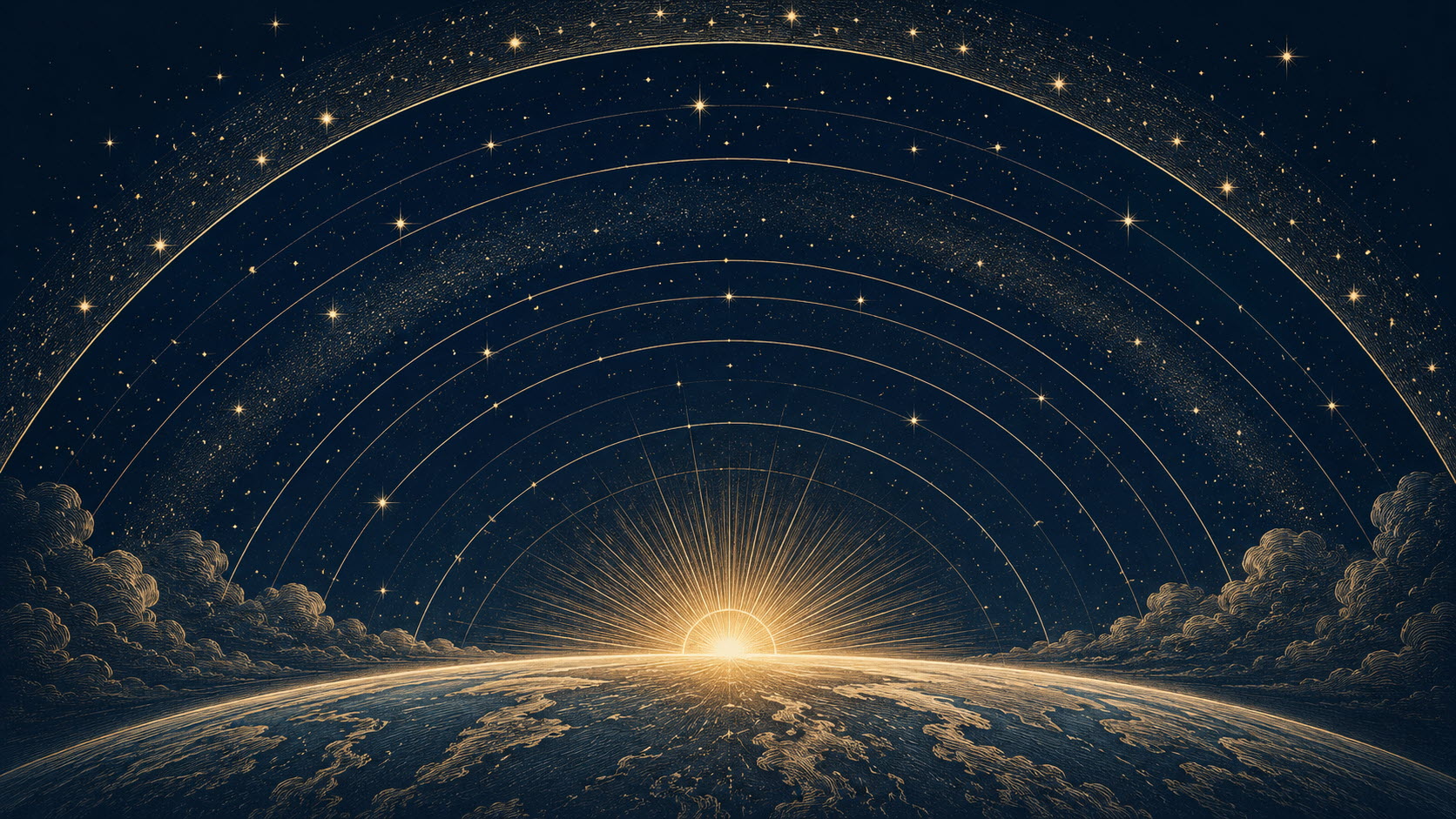
The Human Center of the Sky: Planet Earth
One of the oldest accusations against astrology is that it belongs to a discarded universe. Once the Earth was no longer understood as the physical centre of creation, the argument goes, astrology should have collapsed with it. If the planets do not literally revolve around us, how can they meaningfully speak to us?
But this objection misunderstands what astrology is doing.

THE HUMAN CENTRE OF THE SKY
Here at Home on Planet Earth
One of the oldest accusations against astrology is that it belongs to a discarded universe. Once the Earth was no longer understood as the physical centre of creation, the argument goes, astrology should have collapsed with it. If the planets do not literally revolve around us, how can they meaningfully speak to us?
But this objection misunderstands what astrology is doing.
Astrology is not a claim that the Earth is the mechanical centre of the universe. It is a symbolic language rooted in human experience. It begins where we begin: standing on this Earth, looking up. We do not say, in ordinary speech, that the Earth has rotated eastward beneath our feet until the Sun has entered our field of vision. We say, simply and truthfully, that the Sun rose.
That is not bad astronomy. It is human language.
The same is true of astrology. It describes the heavens as they appear from the place where life is actually lived. The sky that matters symbolically is not an abstract diagram seen from nowhere. It is the sky above us, the horizon around us, the lights that rise and culminate and set, the Moon that swells and wanes, the stars that tremble in the dark.
Every center depends on the question being asked. The Sun may be the centre of the solar system. The galaxy has its own center. Galaxies themselves move within larger structures. But the center of human experience is here: this body, this ground, this breath, this life.
Astrology honours that center.
The old planetary order makes sense when seen this way. It is not arranged by modern physical distance from the Sun, but by visible motion from Earth. The Moon moves fastest and appears nearest to us. Mercury moves more slowly than the Moon, Venus more slowly than Mercury, the Sun with its sovereign yearly rhythm, Mars more slowly still, then Jupiter, then Saturn. Beyond them lie the fixed stars, so distant and steady that they seem almost motionless, glittering at the edge of the known world.
This sequence is not merely astronomical. It is psychological and spiritual. It gives us a map of the human person.
The first light beyond Earth is the Moon. She is need, body, memory, belonging. She speaks of infancy, nurture, instinct, habit, and the emotional climate in which we live. Before we think, choose, strive, judge, or build, we must be held. The Moon tells us how we seek comfort, how we respond before we have words, and what kind of care allows us to feel safe enough to become ourselves.
Then comes Mercury, the quicksilver principle of mind. Mercury names, translates, questions, connects. It is language, perception, curiosity, and wit. Through Mercury we ask what things mean. We learn to listen and speak. We discover that life is not only felt but interpreted. The Moon receives the world; Mercury begins to understand it.
Together, Moon and Mercury describe the first inner architecture of a person: feeling and thought, memory and meaning, instinct and interpretation. Much of what we call personality begins here, in the fusion of what we feel and what we tell ourselves about what we feel.
But we do not remain enclosed within ourselves. Venus draws us outward. Venus says yes and no. This delights me; that repels me. This person attracts me; that situation drains me. Venus is pleasure, affection, beauty, desire, harmony, and value. Through Venus we discover that the world is not neutral. Some things call to the soul. Some things are loved.
Then comes the Sun.
The Sun is not merely ego, though it can be reduced to that when poorly lived. At its best, the Sun is vocation: the heart’s organizing fire. It asks what we are here to become. It gathers the earlier functions into a centre of purpose. We are not only creatures of need, thought, and preference. We are called. There is something in us that wants to shine, not as vanity, but as participation in life.
Mars follows because purpose requires courage. To live is to act. To choose one path is to refuse another. To protect what matters, we sometimes have to stand firm. Mars is not simply anger or conflict. Mars is the power to move, defend, pursue, sever, and begin. Without Mars, the Sun dreams but does not act. With Mars, the soul takes up its tools and enters the world.
But action needs judgment. This is Jupiter’s realm. Jupiter asks what is good, wise, generous, lawful, and meaningful. It forms our worldview, our faith, our ethics, our sense of proportion. A healthy Jupiter enlarges life without inflating the self. It brings mercy to judgment and hope to effort. It reminds us that the good life is not only successful, but spacious.
Finally, Saturn stands at the edge of the visible planetary order. Saturn is time, consequence, limitation, discipline, endurance, and wisdom. It tests what we build. It asks whether our lives can bear weight. Saturn is often feared because it slows us down, but it does not exist merely to deny us. Saturn teaches us to become real.
Where Jupiter rewards trust, Saturn rewards labour. Where Jupiter opens the road, Saturn asks whether we can walk it. Success and failure both belong to Saturn, because both become experience. And experience, accepted honestly, becomes wisdom.
This is the great dignity of the classical seven planets. They are not floating personality traits. They are organs of the self. They describe the human being as a living cosmos: body, mind, desire, purpose, courage, judgment, and responsibility.
And then, beyond Saturn, the fixed stars.
The stars do not replace the planets. They intensify them. They bring strange colour, pressure, brilliance, and sometimes danger. If the planets are the core powers of the person, the stars are like ancient fires touching those powers with mythic force. They do not speak in the ordinary grammar of the self. They arrive with a larger music.
This is why astrology still matters.
Not because it competes with astronomy. Not because it denies modern science. Not because it asks us to retreat into a dead cosmology. Astrology matters because it preserves something modern life often forgets: that human beings need meaning, not only measurement.
We live beneath a sky. We experience time qualitatively, not merely mechanically. Some seasons ripen us. Some transits test us. Some moments open doors. Some thresholds ask us to become more honest, more courageous, more ourselves.
Astrology begins with the human centre, not because we are the most important thing in the universe, but because this is where our responsibility begins. Here. In this life. On this Earth. Under this sky.
To read a birth chart well is to ask: how is this person being invited to live more fully? Where is there hunger? Where is there fear? Where is there beauty? Where is the soul trying to become articulate? Where is life asking for courage, mercy, discipline, or release?
That is the work.
And it is not abstract. It is personal, practical, and deeply human.
If you are ready to explore your own sky in this spirit—not as fortune-telling, but as a conversation with meaning—I would be glad to walk with you. Book a session, bring your questions, and we will look together at the pattern of your life beneath the stars.
Continue exploring…
For more articles about astrology, faith, meaning, memoir, and the life we share beneath the sky, explore Reflections.